Publishing
Versailles à la rencontre du Taj Mahal
Éditions Les Belles Lettres, 2024
Enlightened conversations about India in the age of the Sun King
A book by Faith E. Beasley. Translated by Patrick Graille.
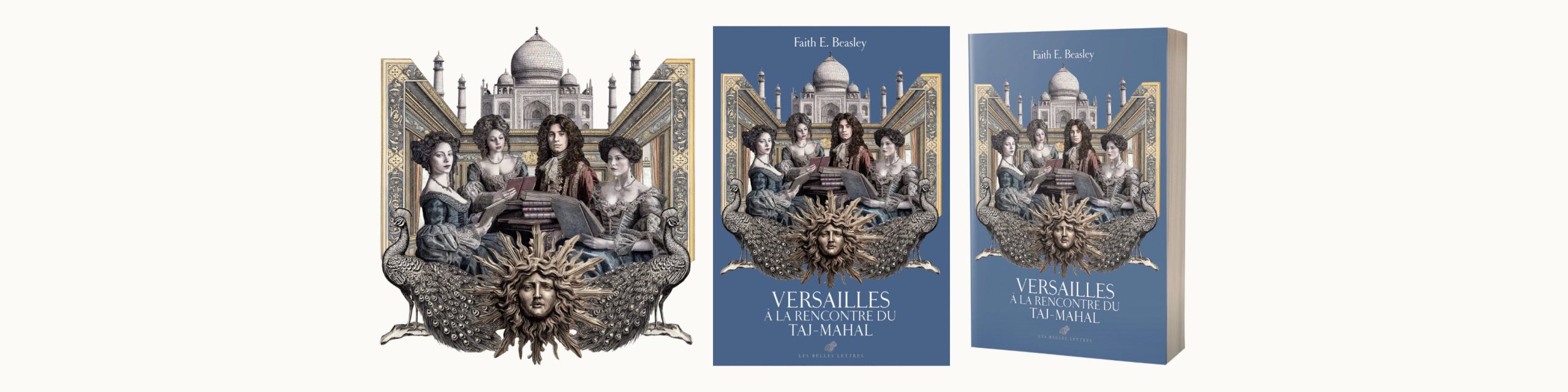
For Les Belles Lettres, I created the cover illustration for Versailles à la rencontre du Taj Mahal (Versailles Meets the Taj Mahal), a book by the American historian Faith E. Beasley on the intellectual, cultural and artistic exchanges between the France of Louis XIV and the India of the Great Mughals.
The book explores a little-known aspect of the Grand Siècle: the fascination of French intellectual elites with Indian civilisation. Through travellers’ accounts, the writings of philosophers and the conversations of literary salons, the author shows how the discovery of India helped nourish the thought, literature and debates of seventeenth-century French society.
To convey this meeting of two civilisations, I imagined a composition bringing together two worlds that were geographically distant yet historically linked by the circulation of ideas.
In the foreground, I depicted a seventeenth-century French literary salon. The figures are gathered in an aristocratic interior, in a conversation evoking the intellectual exchanges of the period. These salons, often led by cultivated and influential women, were essential places for spreading knowledge, where writers, scholars, philosophers and travellers shared their discoveries and debated their ideas.
The scene refers in particular to the intellectual circle of Marguerite de La Sablière, who welcomed figures such as Jean de La Fontaine and the traveller François Bernier. After spending several years at the court of the Great Mughal, Bernier helped introduce French readers to the society, customs and intellectual traditions of India.
In the background, I chose to bring in the Taj Mahal, the emblematic monument of Mughal architecture, built in the seventeenth century under the emperor Shah Jahan. Its instantly recognisable silhouette, with its great dome and minarets, introduces the architectural and cultural world of India into the composition.
The presence of the Taj Mahal behind the French salon is therefore not a mere exotic reference. It symbolises India as it was described, imagined and discussed in the intellectual circles of the kingdom of France. The monument appears almost as a vision born of the figures’ conversation, giving form to the travel accounts and knowledge then circulating between the two continents.
I deliberately brought these two spaces together in a single image, removing the geographical distance between them. The literary salon thus becomes a window opening onto India, while the Taj Mahal represents the cultural and intellectual horizon towards which the figures turn.
The ink drawing, inspired by old engravings, unifies these two architectural worlds. The work on line, texture and detail creates a visual continuity between the elegance of French interiors and the monumentality of Mughal architecture.
Through this cover, I wanted to depict an encounter that did not necessarily take place physically, but that truly existed in books, accounts and conversations. The illustration thus conveys the central idea of the book: long before today’s cultural exchanges, the France of the Grand Siècle was already looking towards India with curiosity, admiration and intellectual interest.
Published in September 2024 by Les Belles Lettres, Versailles à la rencontre du Taj Mahal invites readers to rediscover this history of exchanges between French and Indian cultures, through the essential role played by literary salons and the women who led them.


