lorem ipsum sit dolor ans a quest for design lorem ipsum dolor sit amet, consectetur adipiscing elit. in nisl enim, placerat et ultrices id, egestas a auge. donec iaculis iaculis aliqam. donec bibendum rhoncus.

Part III. LES GRECS / éditions Les Belles Lettres

Six illustrations du livre publié aux Belles Lettres – partie III

Dans Les Grecs, Isaac Asimov retrace l’histoire fondatrice du monde grec en la plaçant, dès l’origine, dans une tension permanente entre deux rives: l’Europe et l’Asie.

Depuis les premiers mythes jusqu’aux grands bouleversements politiques, l’épopée grecque se construit dans l’affrontement (Grèce et Troie, Grèce et Perse, Grèce et Empire ottoman) un conflit de civilisations qui se prolonge au fil des siècles.

Les six  derniers dessins présentés ici illustrent les chapitres 13 à 18 du livre. Chacun d’eux propose une reconstitution visuelle rigoureuse, nourrie par les sources historiques et archéologiques, tout en laissant place à une interprétation graphique sensible.

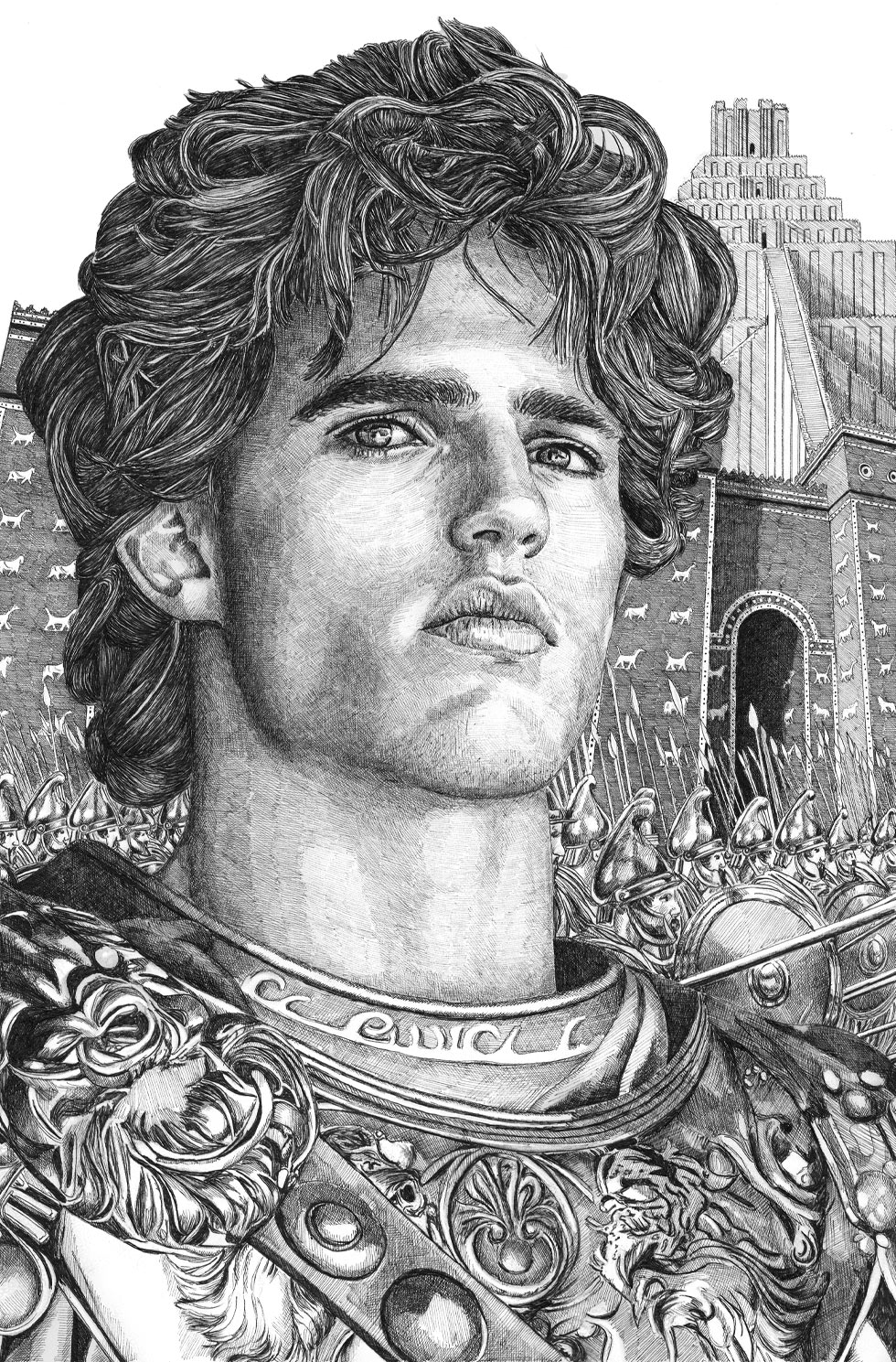
Dessin XIII – La Macédoine

Alexandre le Grand, vêtu d’une armure ornée et d’un manteau royal, domine la scène en tant que conquérant invincible. En arrière-plan, son armée macédonienne avance en formation de phalange. Les célèbres casques phrygiens et les longues sarisses symbolisent l’ingéniosité militaire de cette époque. La cité de Babylone, avec la porte d’Ishtar et sa ziggourat, illustre l’étendue de son empire.

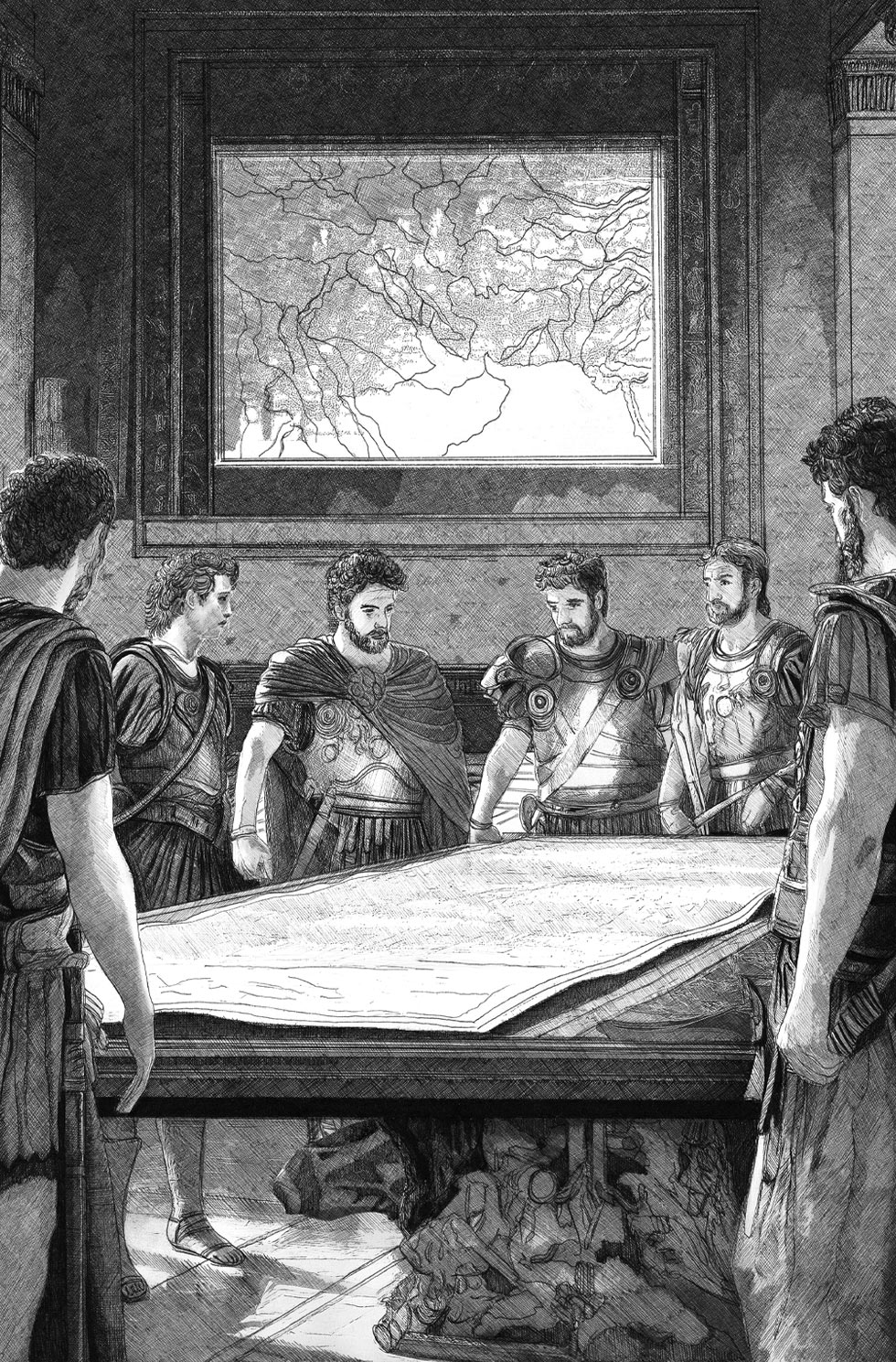
Dessin XIV – Les successeurs d’Alexandre

Les Diadoques, héritiers d’Alexandre le Grand, sont réunis autour d’une table dans une scène symbolisant les intrigues de cette époque. Ptolémée I, Séleucos I, Antigone le Borgne, Cassandre, Lysimaque et Perdiccas prétendent à la succession de l’empire, tout en tissant des alliances et des trahisons. Deux cartes du gigantesque empire d’Alexandre occupent une place centrale, l’une posée sur la table, l’autre accrochée au mur. Le cadre majestueux du palais rappelle la grandeur de l’empire disparu.

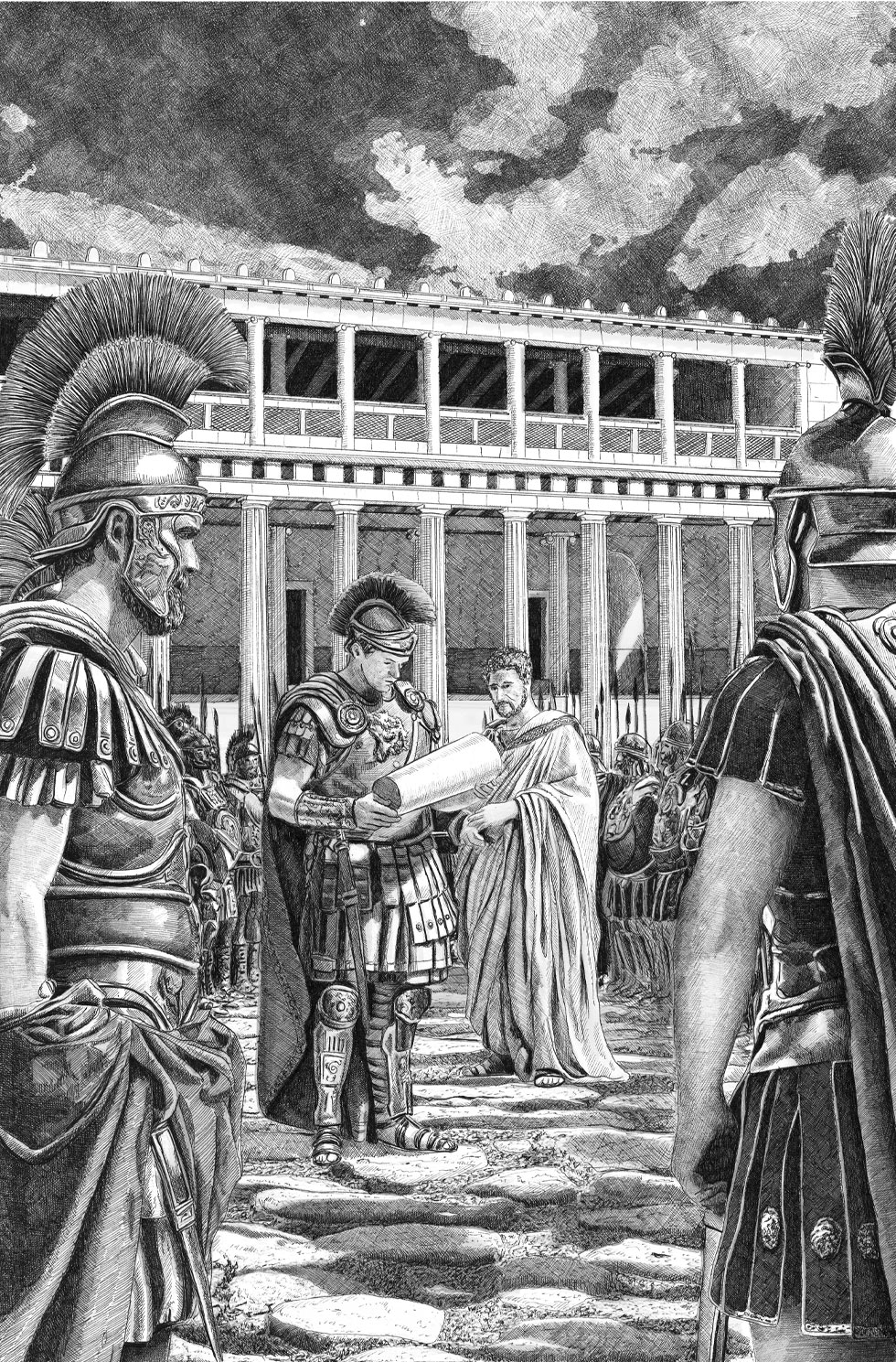
Dessin XV – Le crépuscule de la liberté

Le conseil de la Proclamation se déroule sur l’Agora grecque, devant la Stoa d’Attale. Un général romain lit la proclamation officialisant la soumission des cités grecques à Rome. Autour de lui, l’armée romaine forme un cercle serré, symbolisant la domination totale de Rome. Le contraste entre les soldats romains et l’architecture grecque met en lumière la transformation de la Grèce sous l’influence romaine.

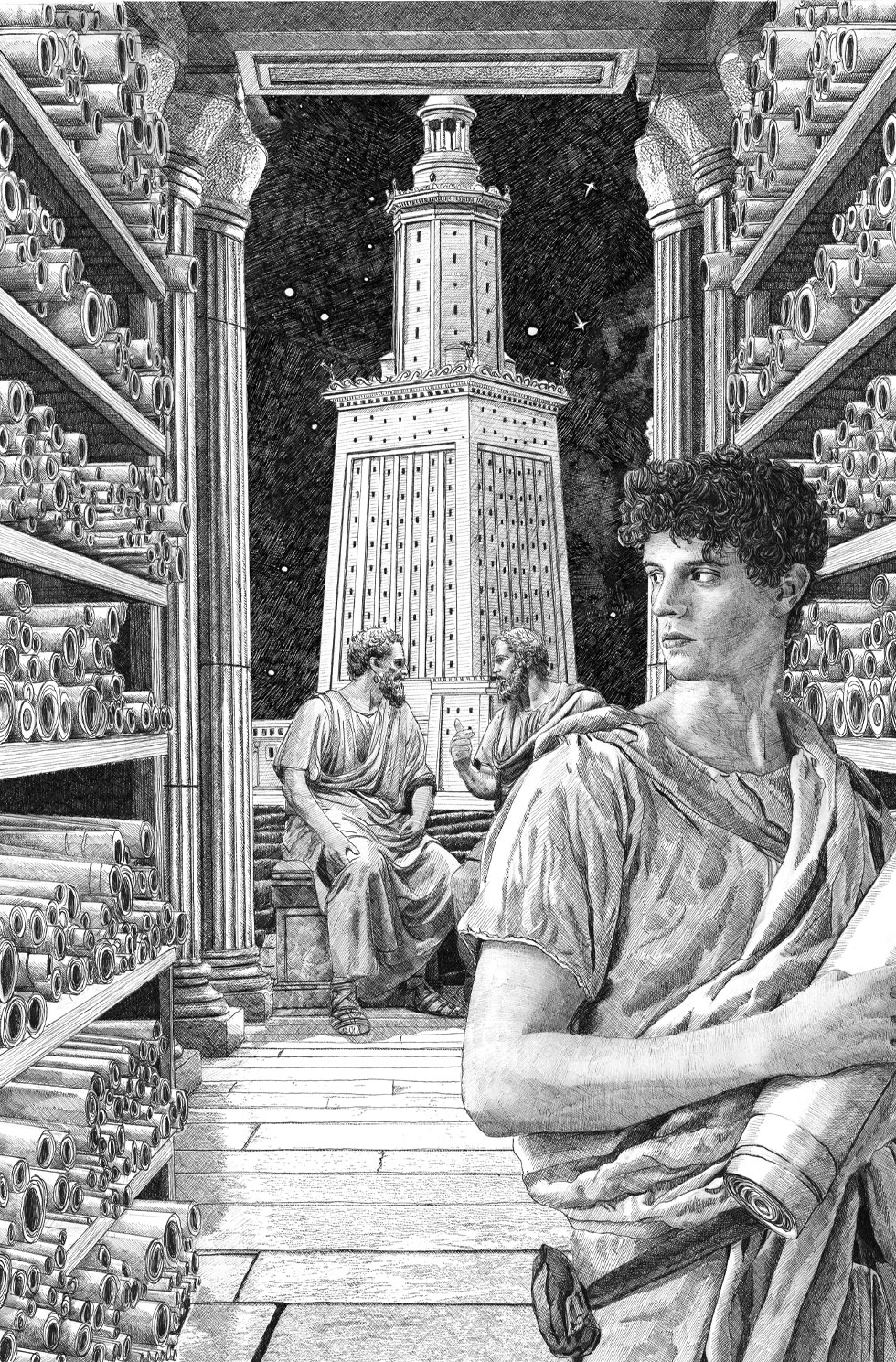
Dessin XVI — Les monarchies héllénistiques

L’intérieur de la Bibliothèque d’Alexandrie révèle une grande salle, avec des étagères remplies de rouleaux de papyrus soigneusement organisés. Au fond de la salle, deux érudits discutent, incarnant l’esprit de la recherche intellectuelle. Le phare d’Alexandrie se dresse en arrière-plan, symbole de la grandeur de la ville.

dessin XVII – Rome et Constantinople

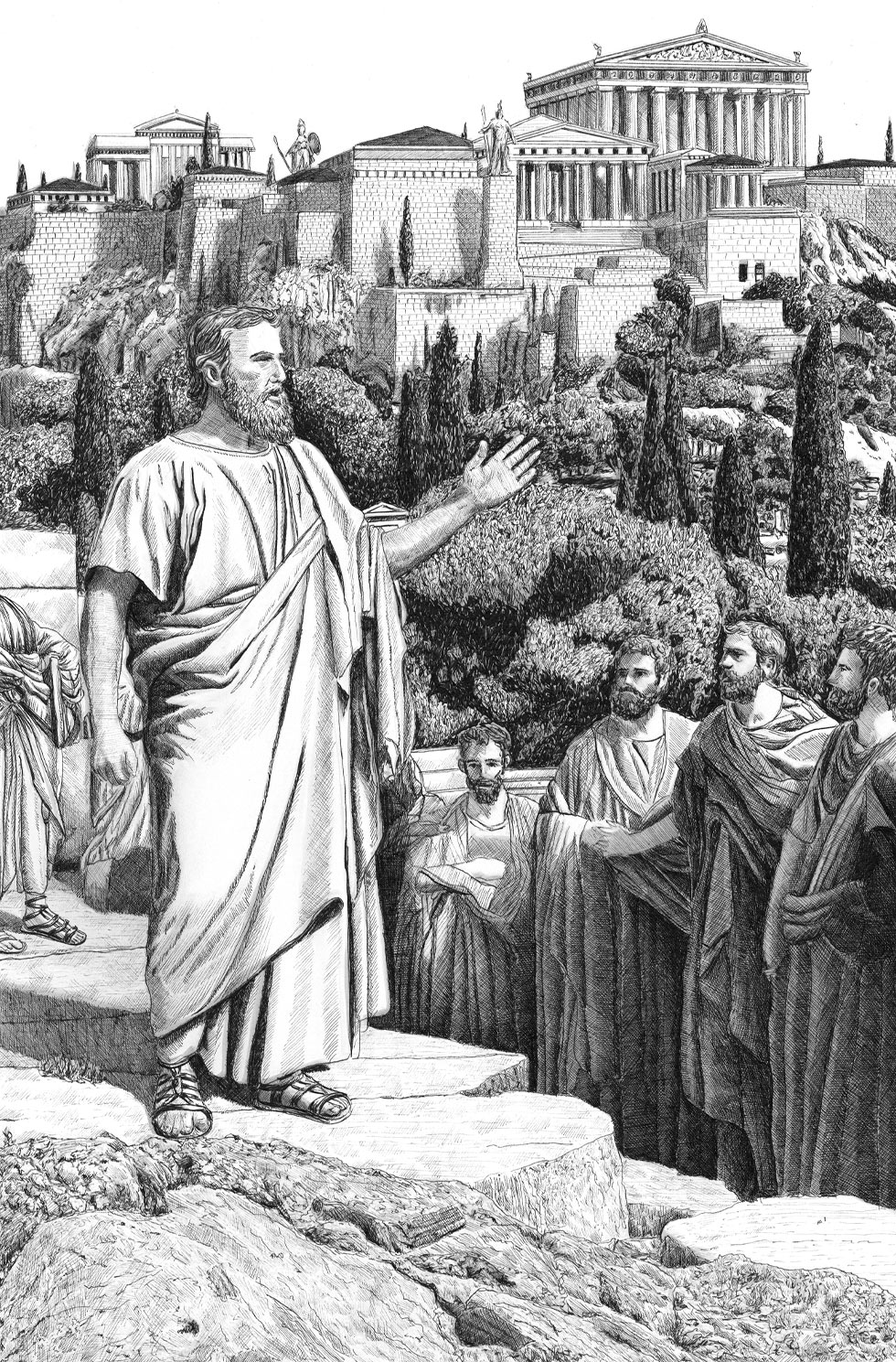
Saint Paul évangélise sur la roche de l’Aréopage, face à une foule athénienne sceptique. L’Acropole se dresse en arrière-plan, fidèle à son emplacement historique. Cette scène marque un tournant dans la diffusion du Christianisme et l’émergence d’une nouvelle religion monothéiste face au polythéisme grec.

Dessin XVIII – L’Empire Ottoman

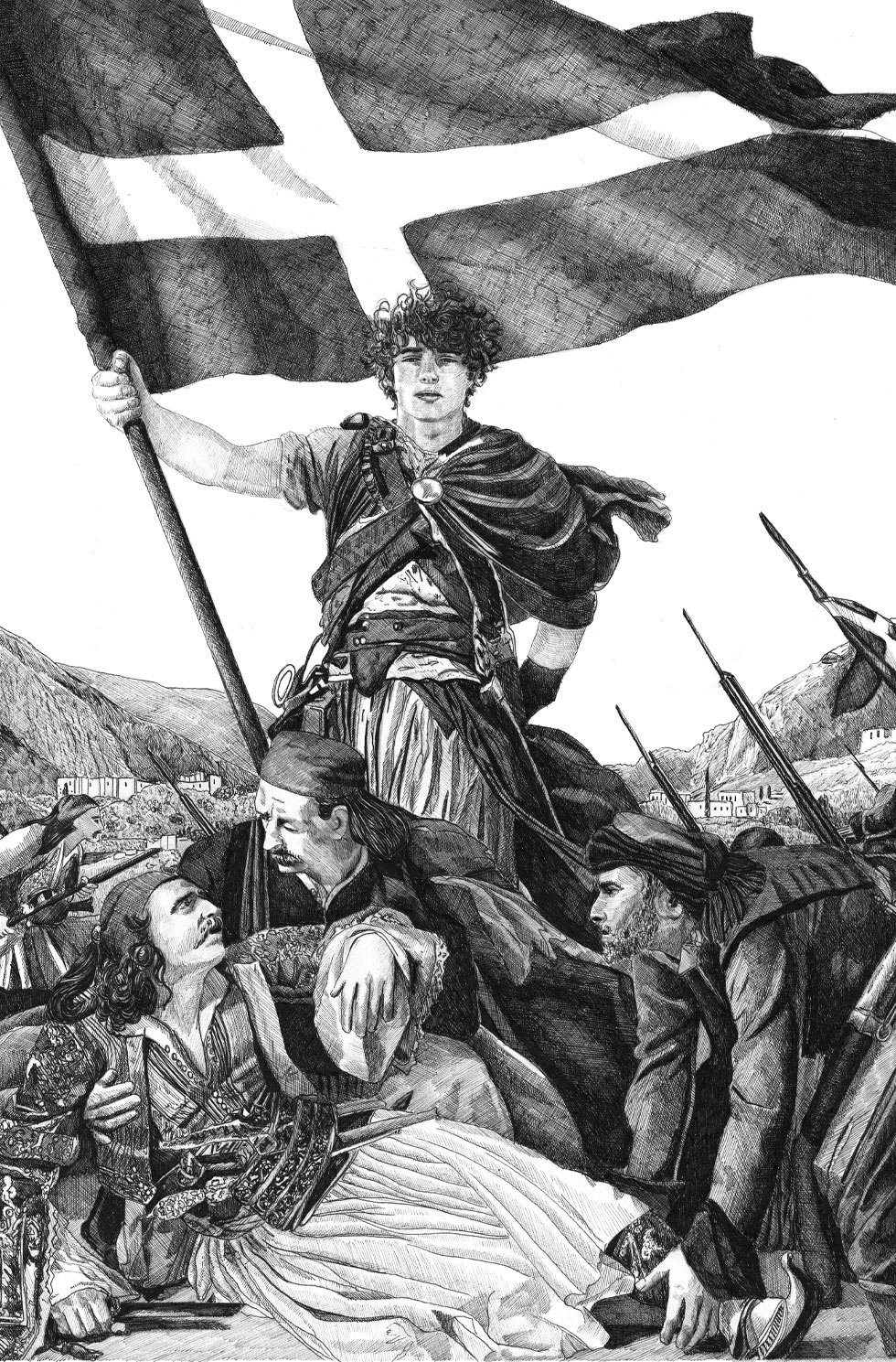
Un soldat grec, symbole de la Grèce nouvelle, tient fièrement le drapeau grec sur un champ de bataille, probablement à Missolonghi. Cette scène, inspirée par le tableau « La Mort de Markos Botzaris », rend hommage aux sacrifices héroïques nécessaires à la création de la Grèce moderne. Le soldat incarne l’espoir et la grandeur de la Grèce indépendante, en lutte contre la domination ottomane.

——————————————

PRESSE

Asimov tisse ainsi un réseau intéressant d’informations assez brutes, permettant au lecteur d’enrichissants allers-retours. Magnifiquement illustré par Benjamin Van Blancke, il montre l’apport de cette civilisation méditerranéenne à la nôtre.

La Liberté – 23/05/2025

Une bonne introduction à l’Antiquité grecque et un témoignage des approches scientifiques des années 1960

Beaux Arts Magazine – 01/07/2025

Avec une densité étonnante, Asimov ramène à l’essentiel l’épopée grecque. La grandeur austère de Sparte, la vivacité politique d’Athènes ou encore lesconquêtes foudroyantes d’Alexandre prennent ici une fraîcheur rare, sans longueurs inutiles. On salue, en outre, les illustrations de Benjamin Van Blancke, qui ponctuent ce récit compact d’un trait élégant, évocateur sans pittoresque superflu.

Le Figaro Histoire – 01/06/2025

Le illustrations de Benjamin Van Blancke sont tout simplement magnifiques. Son trait, précis et poétique, nous transporte dans le temps, nous fait sentir la chaleur du soleil grec, la fraîcheur de la mer Égée. Elles sont un écrin parfait pour le texte d’Asimov, un enchantement pour les yeux.

Hoirizonetinfini sur Instagram – 01/07/2025


https://www.lesbelleslettres.com/livre/9782251456959/les-grecs

Six illustrations from the book published by Les Belles Lettres — Part III

In The Greeks, Isaac Asimov retraces the foundational history of the Greek world by placing it, from the very beginning, within a constant tension between two shores: Europe and Asia.

From the earliest myths to major political upheavals, the Greek epic is shaped through confrontation (Greece and Troy, Greece and Persia, Greece and the Ottoman Empire), a clash of civilizations that extends across the centuries.

The final six drawings presented here illustrate chapters 13 to 18 of the book. Each offers a rigorous visual reconstruction, informed by historical and archaeological sources, while allowing room for a sensitive graphic interpretation.

Drawing XIII — Macedonia

Alexander the Great, clad in an ornate suit of armor and a royal cloak, dominates the scene as an invincible conqueror. In the background, his Macedonian army advances in phalanx formation. The famous Phrygian helmets and long sarissas symbolize the military ingenuity of the period. The city of Babylon, with the Ishtar Gate and its ziggurat, illustrates the vast extent of his empire.

Drawing XIV — The Successors of Alexander

The Diadochi, heirs of Alexander the Great, are gathered around a table in a scene symbolizing the intrigues of the era. Ptolemy I, Seleucus I, Antigonus the One-Eyed, Cassander, Lysimachus, and Perdiccas all claim succession to the empire while weaving alliances and betrayals. Two maps of Alexander’s vast empire occupy a central place, one laid out on the table and the other hanging on the wall. The majestic setting of the palace recalls the grandeur of the vanished empire.

Drawing XV — The Twilight of Freedom

The Council of the Proclamation takes place on the Greek Agora, before the Stoa of Attalos. A Roman general reads the proclamation officially submitting the Greek city-states to Rome. Around him, the Roman army forms a tight circle, symbolizing Rome’s total domination. The contrast between the Roman soldiers and Greek architecture highlights the transformation of Greece under Roman influence.

Drawing XVI — The Hellenistic Monarchies

The interior of the Library of Alexandria reveals a vast hall, with shelves filled with carefully organized papyrus scrolls. At the back of the room, two scholars are engaged in discussion, embodying the spirit of intellectual inquiry. The Lighthouse of Alexandria rises in the background, a symbol of the city’s grandeur.

Drawing XVII — Rome and Constantinople

Saint Paul preaches on the rock of the Areopagus, facing a skeptical Athenian crowd. The Acropolis rises in the background, faithful to its historical location. This scene marks a turning point in the spread of Christianity and the emergence of a new monotheistic religion in the face of Greek polytheism.

Drawing XVIII — The Ottoman Empire

A Greek soldier, symbol of the new Greece, proudly holds the Greek flag on a battlefield, likely at Missolonghi. This scene, inspired by the painting The Death of Markos Botsaris, pays tribute to the heroic sacrifices required for the creation of modern Greece. The soldier embodies the hope and grandeur of an independent Greece, struggling against Ottoman domination.

——————————————

PRESS

Asimov thus weaves an engaging network of fairly raw information, allowing the reader for enriching back-and-forth reflections. Magnificently illustrated by Benjamin Van Blancke, the book highlights the contribution of this Mediterranean civilization to our own.

La Liberté — 23/05/2025

A solid introduction to Greek Antiquity and a testimony to the scientific approaches of the 1960s.

Beaux Arts Magazine — 01/07/2025

With remarkable density, Asimov brings the Greek epic back to its essentials. The austere grandeur of Sparta, the political vitality of Athens, and the lightning-fast conquests of Alexander all acquire a rare freshness here, free of unnecessary digressions. Special praise must also be given to the illustrations by Benjamin Van Blancke, which punctuate this compact narrative with an elegant line—evocative without superfluous picturesque detail.

Le Figaro Histoire — 01/06/2025

The illustrations by Benjamin Van Blancke are simply magnificent. His precise and poetic line transports us through time, making us feel the warmth of the Greek sun and the coolness of the Aegean Sea. They are a perfect setting for Asimov’s text, a true enchantment for the eyes.

Horizonetinfini on Instagram — 01/07/2025