Publishing
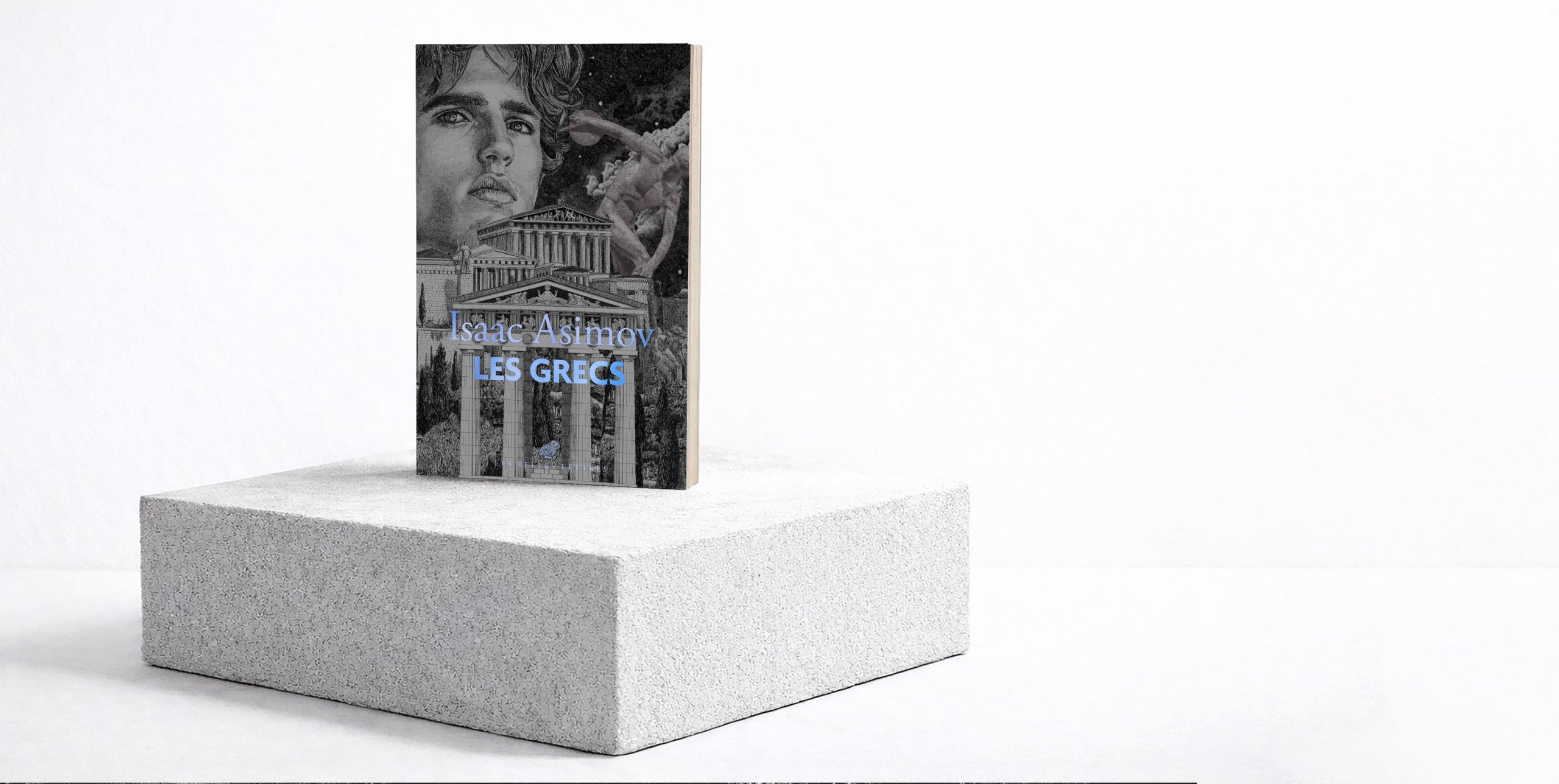
Les Grecs, partie III
Les Belles Lettres
⸻
⸻
⸻
⸻
⸻
⸻
——————————————
PRESSE
Beaux Arts Magazine - 01/07/2025
https://www.lesbelleslettres.com/livre/9782251456959/les-grecs
Six illustrations from the book published by Les Belles Lettres — Part III
In The Greeks, Isaac Asimov retraces the foundational history of the Greek world by placing it, from the very beginning, within a constant tension between two shores: Europe and Asia.
From the earliest myths to major political upheavals, the Greek epic is shaped through confrontation (Greece and Troy, Greece and Persia, Greece and the Ottoman Empire), a clash of civilizations that extends across the centuries.
The final six drawings presented here illustrate chapters 13 to 18 of the book. Each offers a rigorous visual reconstruction, informed by historical and archaeological sources, while allowing room for a sensitive graphic interpretation.
⸻
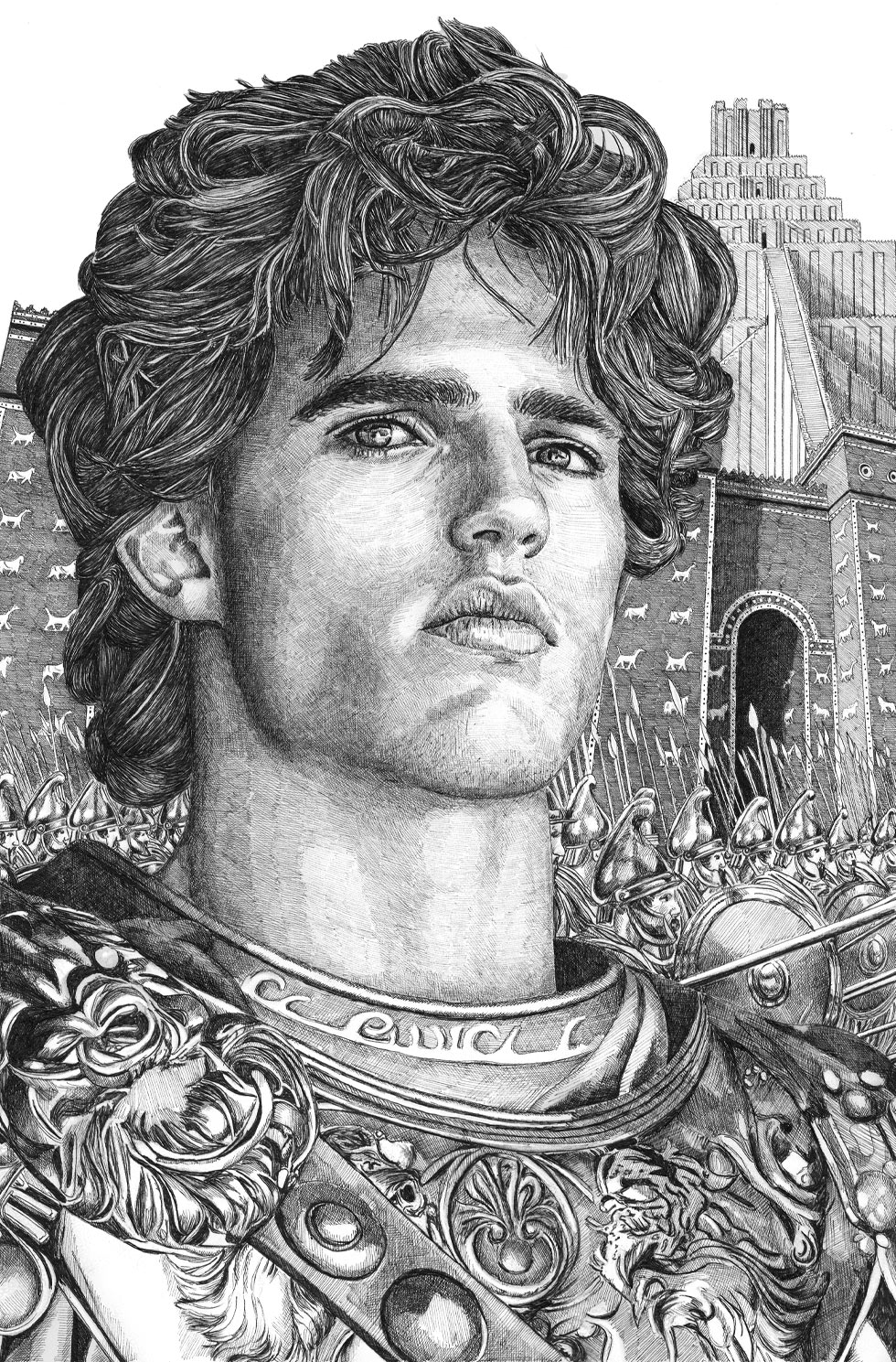
Drawing XIII — Macedonia
Alexander the Great, clad in an ornate suit of armor and a royal cloak, dominates the scene as an invincible conqueror. In the background, his Macedonian army advances in phalanx formation. The famous Phrygian helmets and long sarissas symbolize the military ingenuity of the period. The city of Babylon, with the Ishtar Gate and its ziggurat, illustrates the vast extent of his empire.
⸻
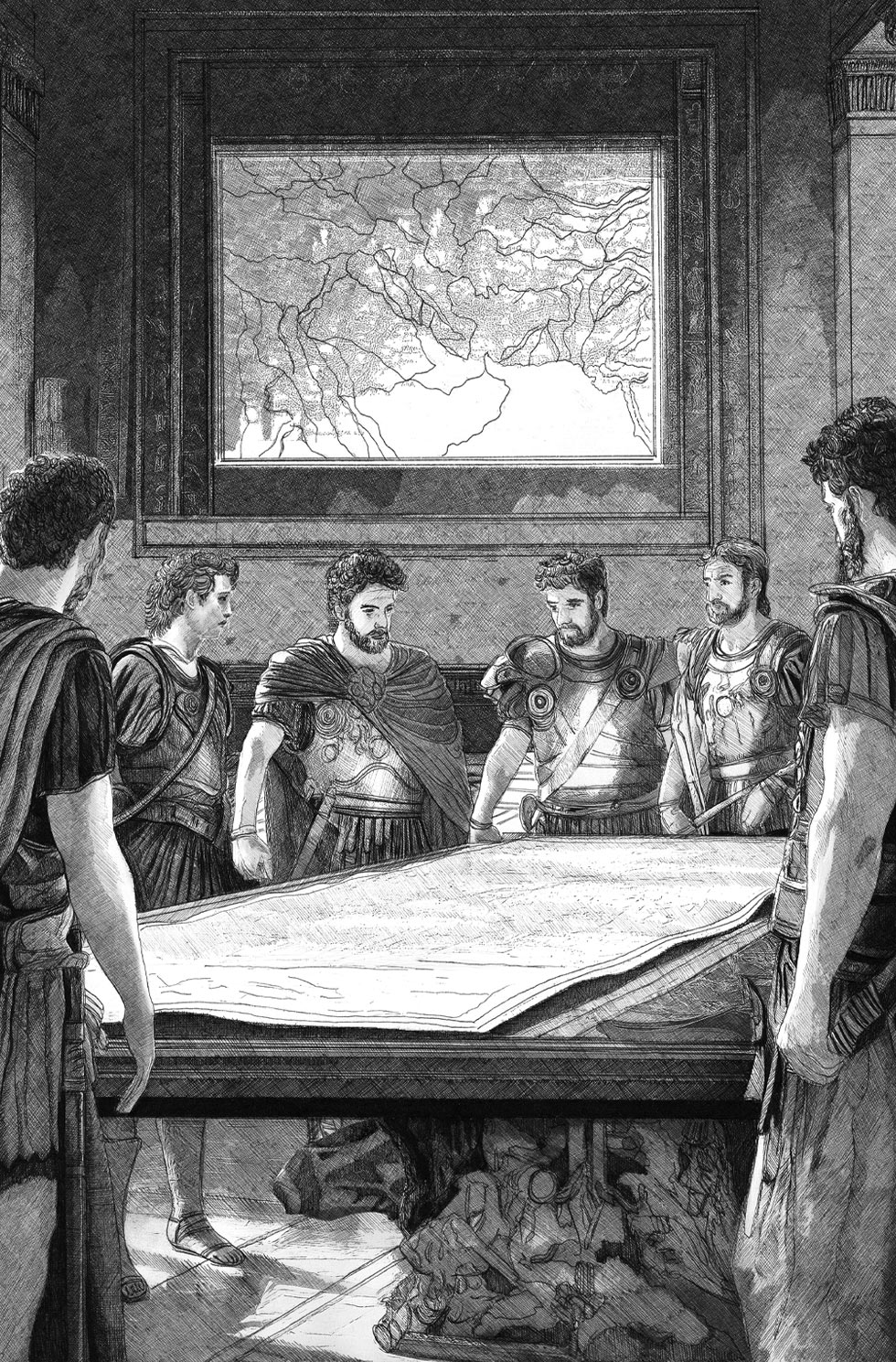
Drawing XIV — The Successors of Alexander
The Diadochi, heirs of Alexander the Great, are gathered around a table in a scene symbolizing the intrigues of the era. Ptolemy I, Seleucus I, Antigonus the One-Eyed, Cassander, Lysimachus, and Perdiccas all claim succession to the empire while weaving alliances and betrayals. Two maps of Alexander’s vast empire occupy a central place, one laid out on the table and the other hanging on the wall. The majestic setting of the palace recalls the grandeur of the vanished empire.
⸻
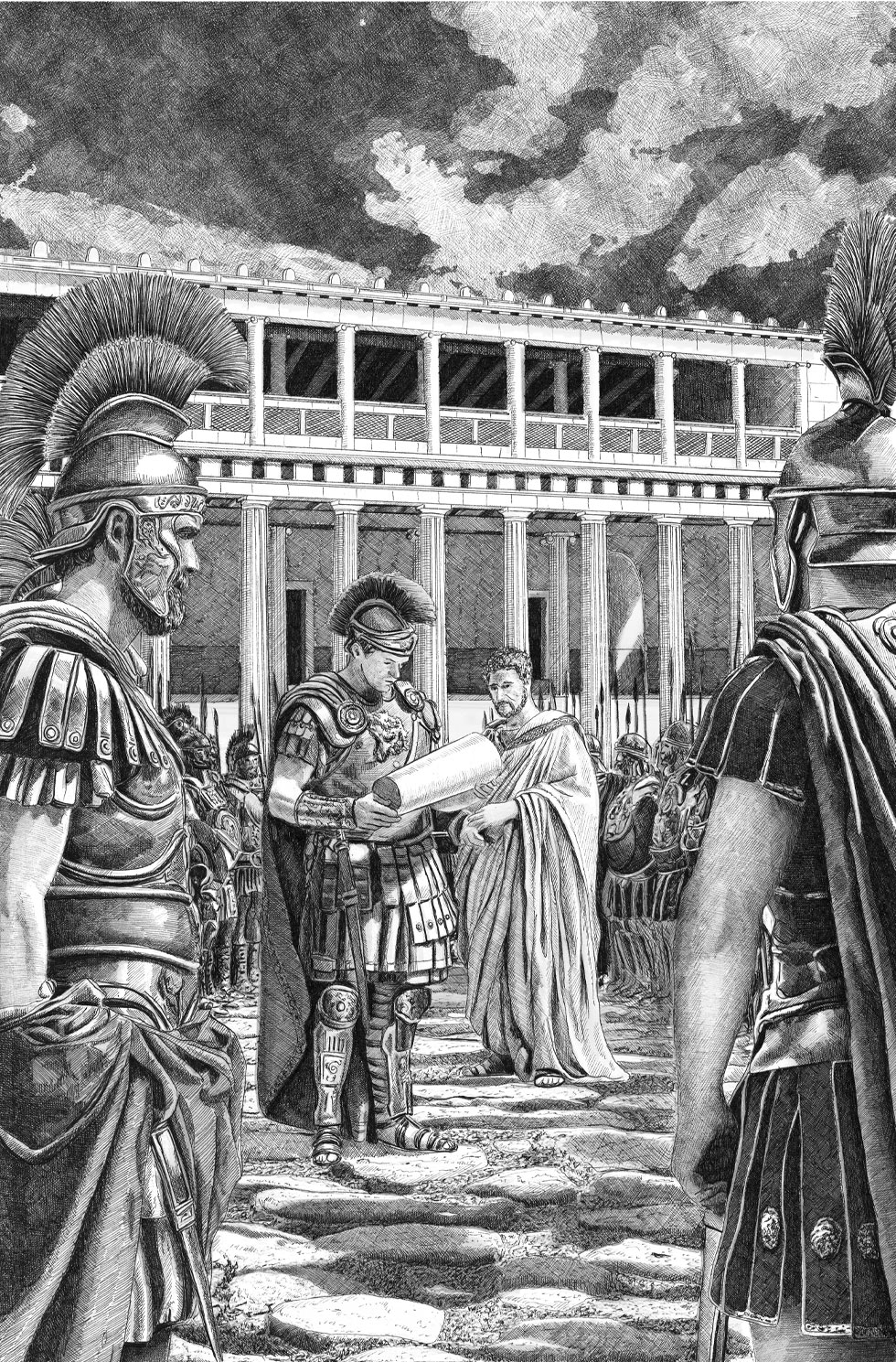
Drawing XV — The Twilight of Freedom
The Council of the Proclamation takes place on the Greek Agora, before the Stoa of Attalos. A Roman general reads the proclamation officially submitting the Greek city-states to Rome. Around him, the Roman army forms a tight circle, symbolizing Rome’s total domination. The contrast between the Roman soldiers and Greek architecture highlights the transformation of Greece under Roman influence.
⸻
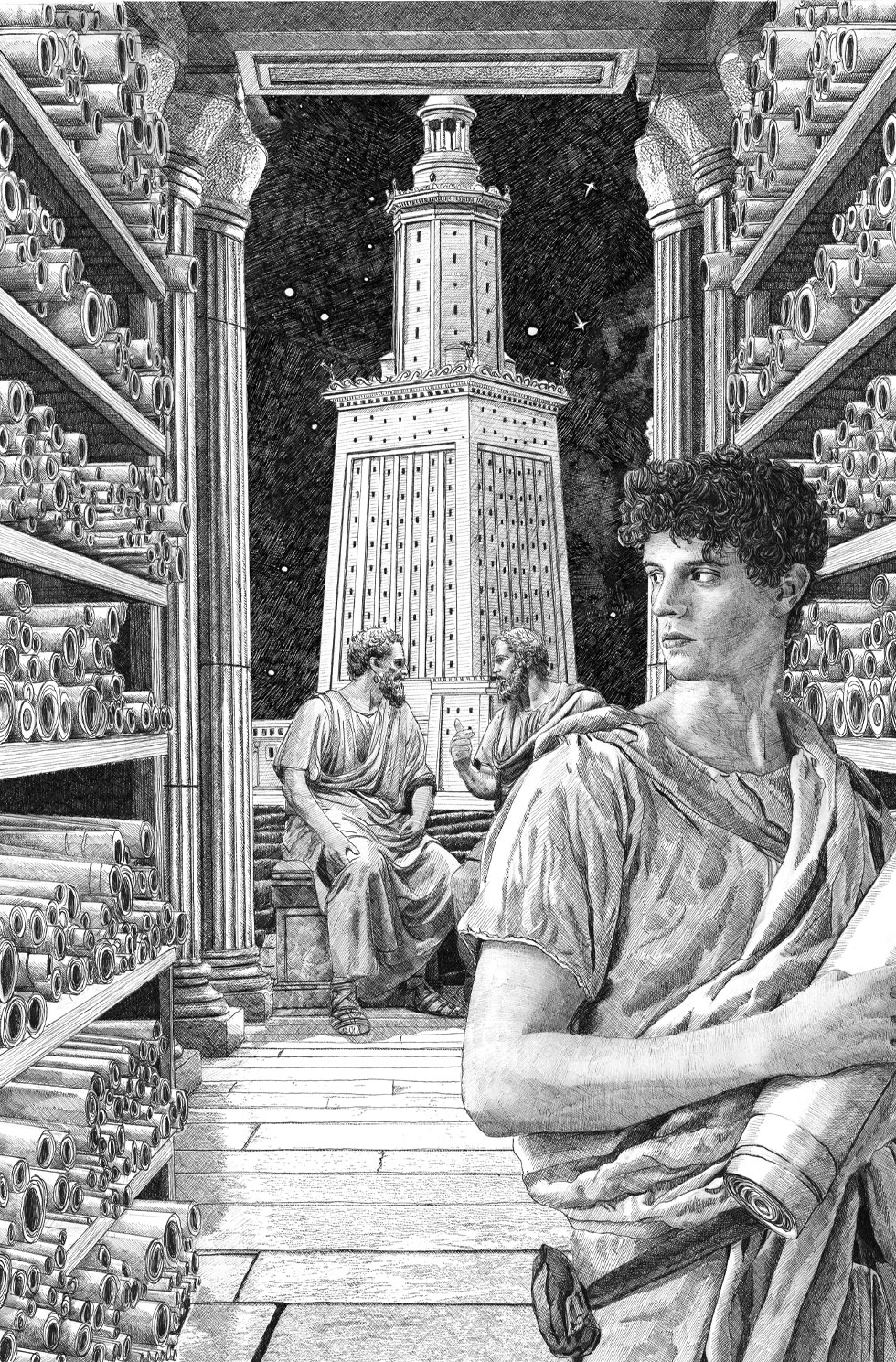
Drawing XVI — The Hellenistic Monarchies
The interior of the Library of Alexandria reveals a vast hall, with shelves filled with carefully organized papyrus scrolls. At the back of the room, two scholars are engaged in discussion, embodying the spirit of intellectual inquiry. The Lighthouse of Alexandria rises in the background, a symbol of the city’s grandeur.
⸻
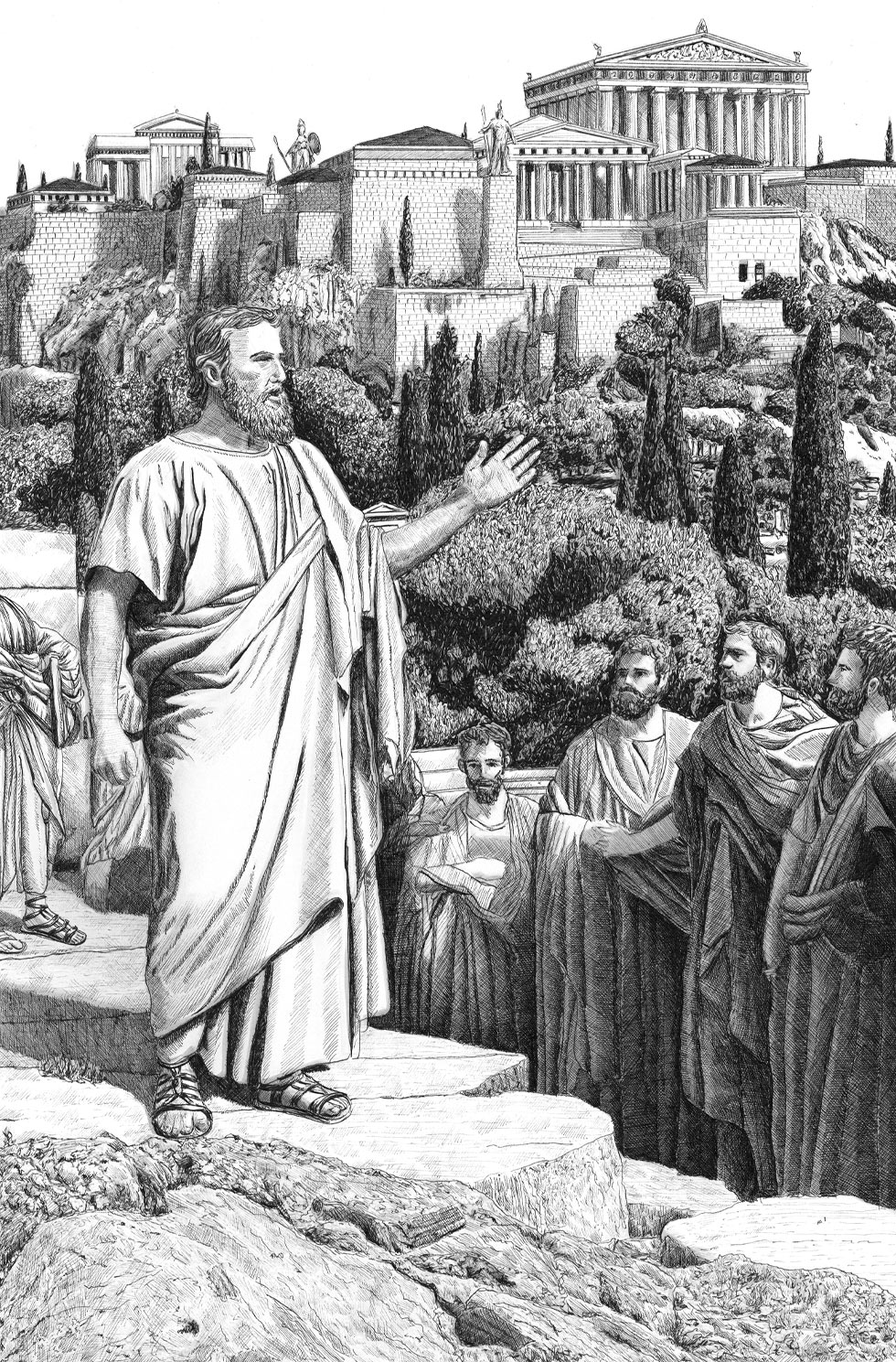
Drawing XVII — Rome and Constantinople
Saint Paul preaches on the rock of the Areopagus, facing a skeptical Athenian crowd. The Acropolis rises in the background, faithful to its historical location. This scene marks a turning point in the spread of Christianity and the emergence of a new monotheistic religion in the face of Greek polytheism.
⸻
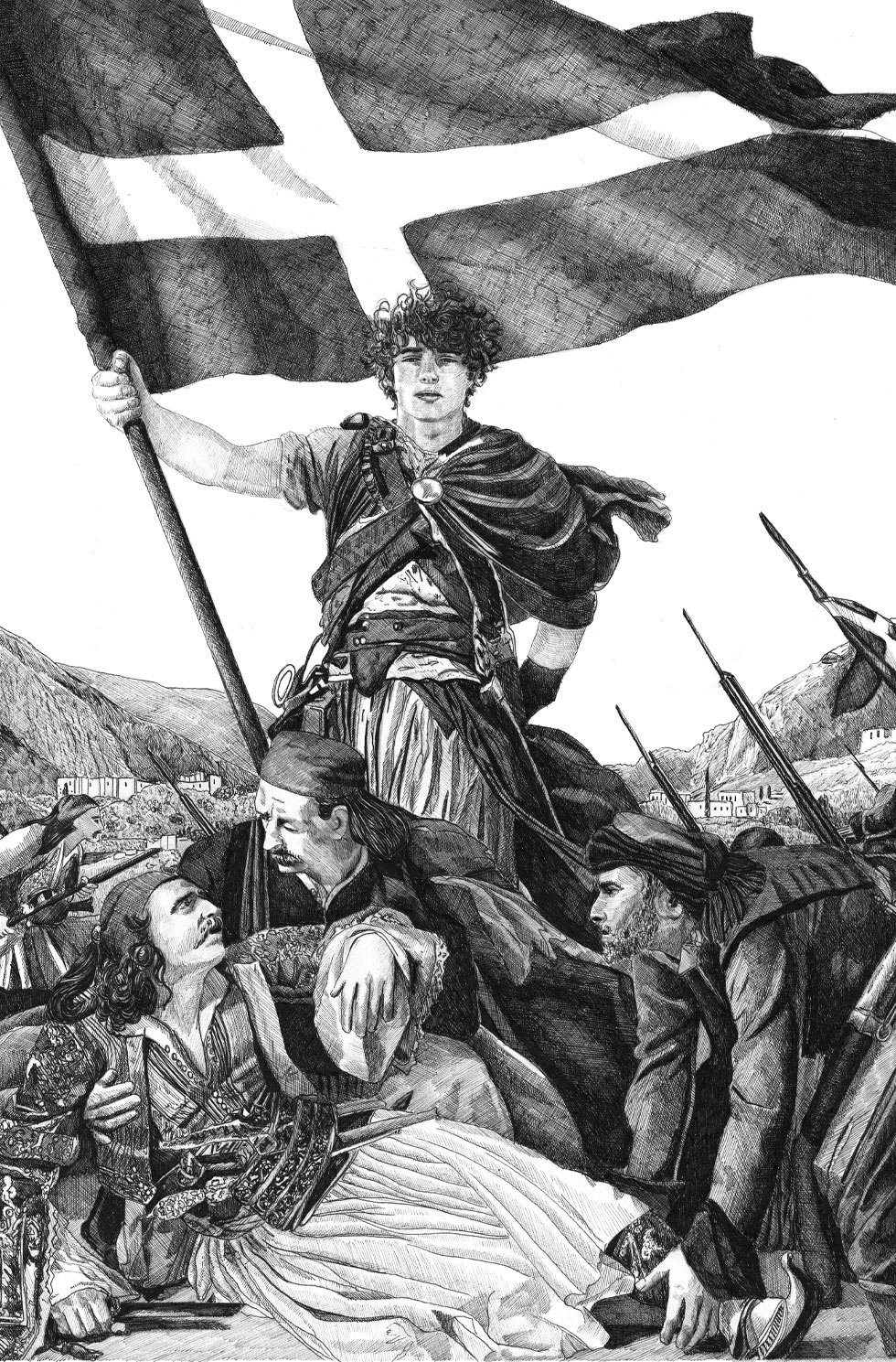
Drawing XVIII — The Ottoman Empire
A Greek soldier, symbol of the new Greece, proudly holds the Greek flag on a battlefield, likely at Missolonghi. This scene, inspired by the painting The Death of Markos Botsaris, pays tribute to the heroic sacrifices required for the creation of modern Greece. The soldier embodies the hope and grandeur of an independent Greece, struggling against Ottoman domination.
——————————————
PRESS
Asimov thus weaves an engaging network of fairly raw information, allowing the reader for enriching back-and-forth reflections. Magnificently illustrated by Benjamin Van Blancke, the book highlights the contribution of this Mediterranean civilization to our own.
A solid introduction to Greek Antiquity and a testimony to the scientific approaches of the 1960s.
Beaux Arts Magazine — 01/07/2025
With remarkable density, Asimov brings the Greek epic back to its essentials. The austere grandeur of Sparta, the political vitality of Athens, and the lightning-fast conquests of Alexander all acquire a rare freshness here, free of unnecessary digressions. Special praise must also be given to the illustrations by Benjamin Van Blancke, which punctuate this compact narrative with an elegant line—evocative without superfluous picturesque detail.
The illustrations by Benjamin Van Blancke are simply magnificent. His precise and poetic line transports us through time, making us feel the warmth of the Greek sun and the coolness of the Aegean Sea. They are a perfect setting for Asimov’s text, a true enchantment for the eyes.
Horizonetinfini on Instagram — 01/07/2025