Publishing
Les Grecs, partie II
Les Belles Lettres
⸻
⸻
⸻
⸻
⸻
⸻
——————————————
PRESSE
Beaux Arts Magazine - 01/07/2025
https://www.lesbelleslettres.com/livre/9782251456959/les-grecs
Six illustrations from the book published by Les Belles Lettres — Part II
In The Greeks, Isaac Asimov retraces the foundational history of the Greek world by placing it, from the very beginning, within a constant tension between two shores: Europe and Asia.
From the earliest myths to major political upheavals, the Greek epic is shaped through confrontation (Greece and Troy, Greece and Persia, Greece and the Ottoman Empire), a clash of civilizations that extends across the centuries.
The six drawings presented here illustrate chapters 7 to 12 of the book. Each offers a rigorous visual reconstruction, informed by historical and archaeological sources, while allowing room for a sensitive graphic interpretation.
⸻
Drawing VII — Asia Minor
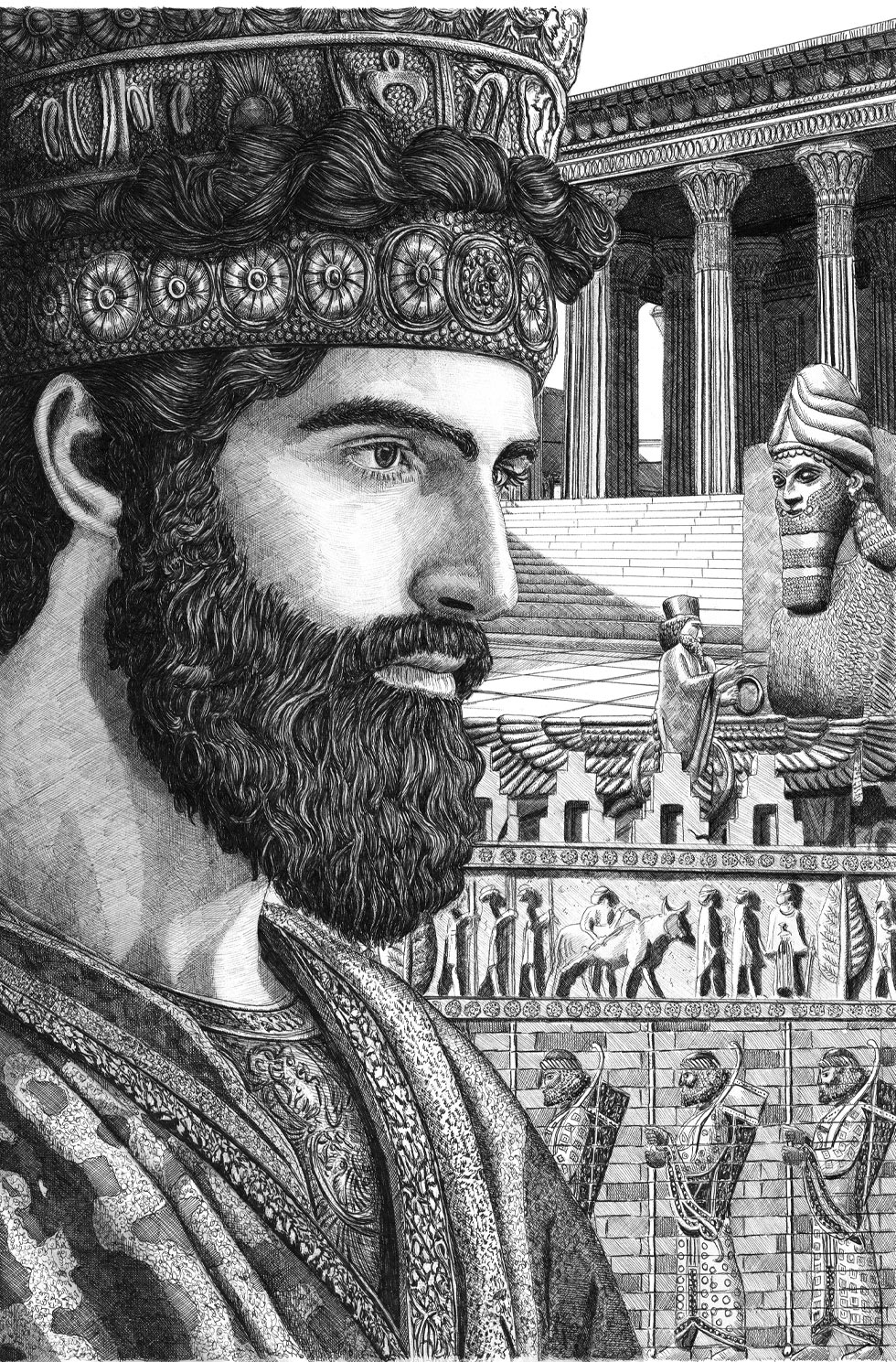
Darius, a symbol of Persian power and one of the most emblematic figures of the Achaemenid Empire, stands before his majestic palace at Persepolis. The monument, dominated by imposing columns and refined sculptures, reflects the grandeur of Persian civilization. On the right, the Faravahar, a central symbol of ancient Persia, represents divine protection. Darius, wearing an Eastern crown and luxurious garments, embodies the authority and magnificence of an empire at its height.
⸻
Drawing VIII — The Persians War
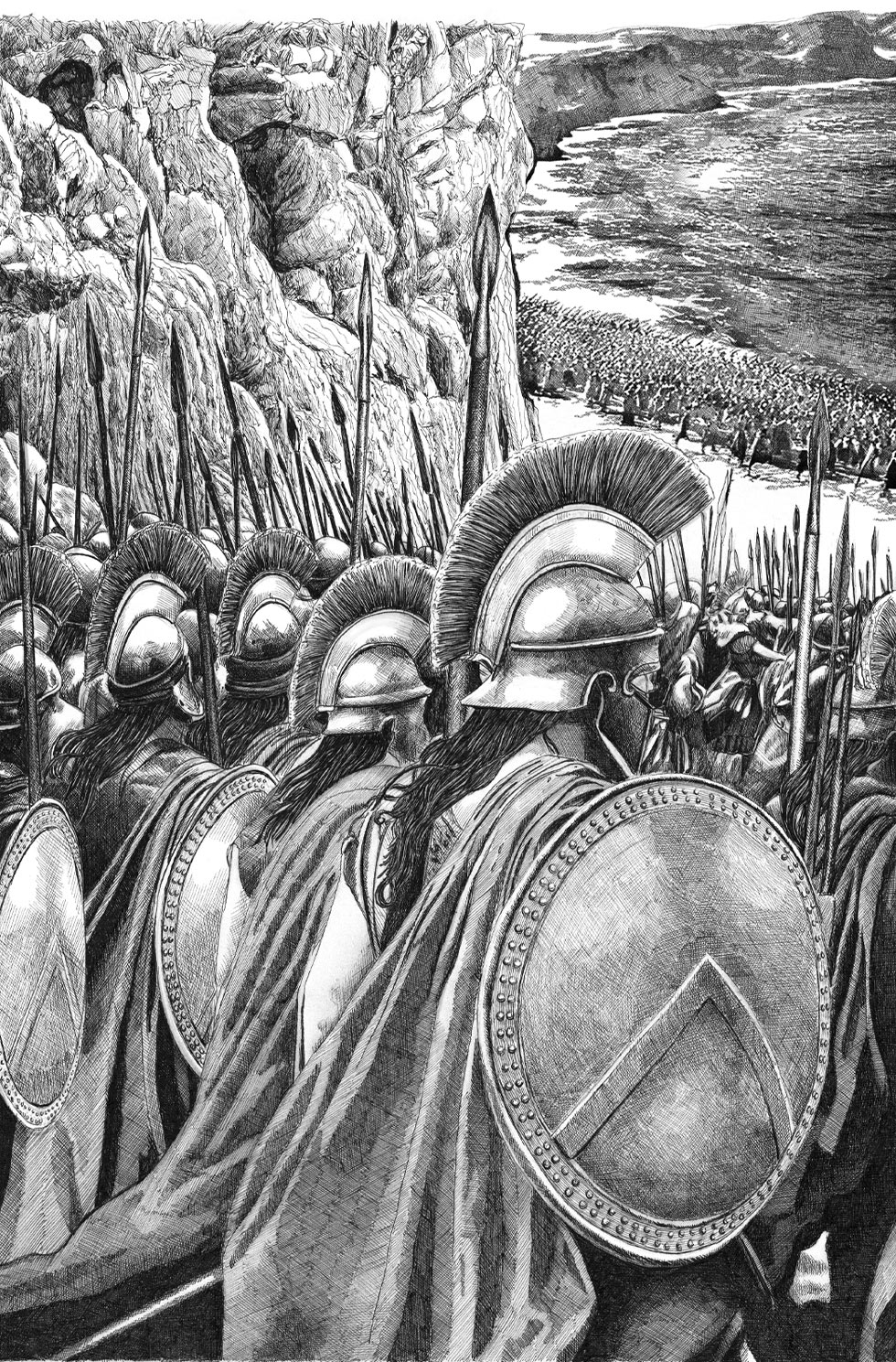
The Spartans, recognizable by their shields marked with the inverted “V,” advance resolutely through the pass of Thermopylae. The Spartan phalanx, seen from behind, embodies discipline and determination. On the left, a steep cliff dominates the scene, while in the background the Persian army looms, massive and threatening. This legendary battle illustrates the courage of the Spartans, who sacrificed themselves to defend Greece against the Persian invader.
⸻
Drawing IX — The Golden Age
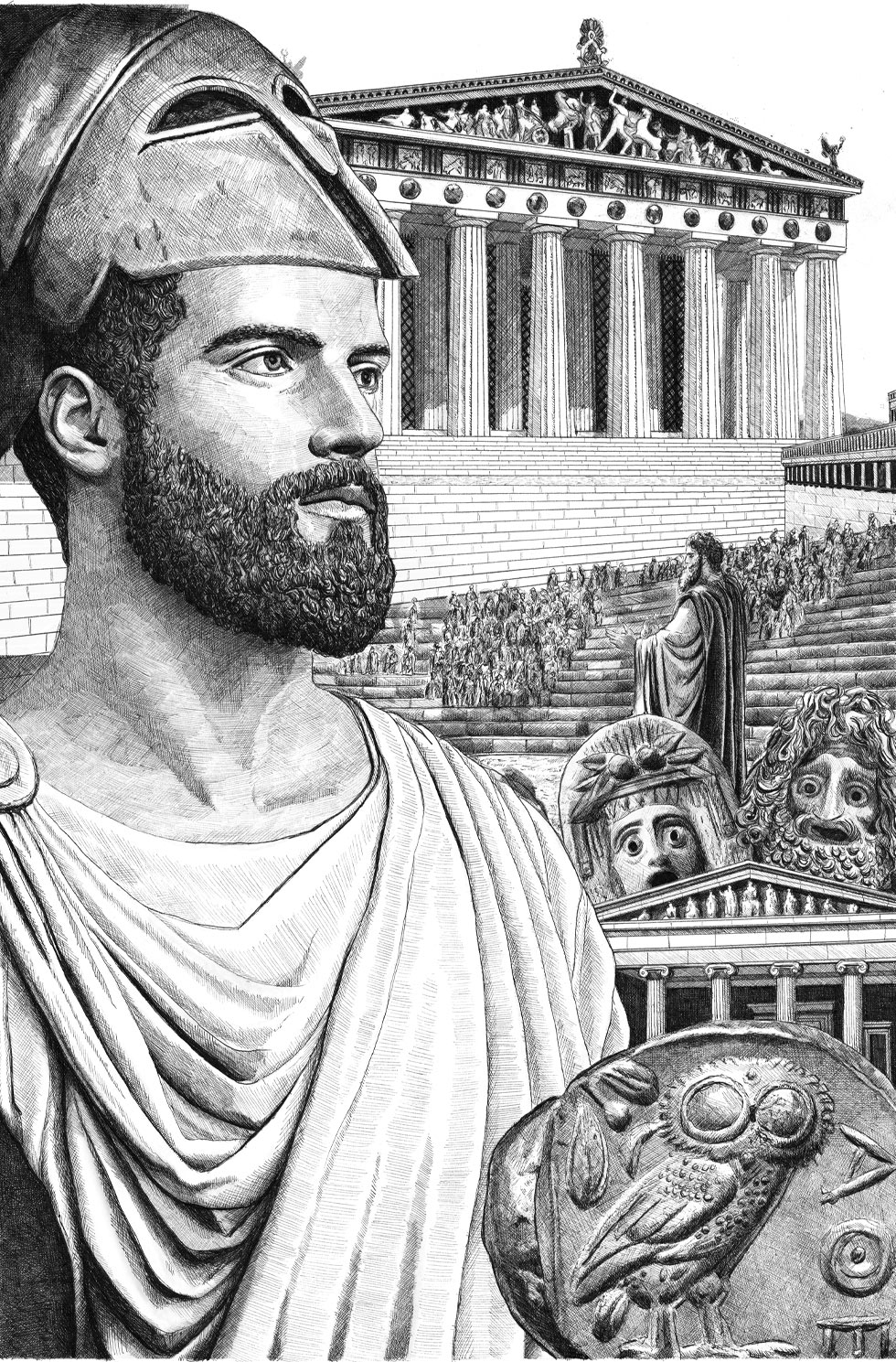
Pericles, an emblematic figure of ancient Athens, stands proudly, wearing his chlamys and helmet. This portrait symbolizes the Golden Age of Athens, marked by unprecedented cultural, artistic, and political influence. In the background, the Parthenon and an ancient theater testify to the city’s apogee. The Greek tragic masks from the age of Pericles, shown at the bottom of the theater scene, were used to exaggerate emotions and character traits in tragedies, allowing actors to play multiple roles. They amplified facial expressions so that emotions could be seen even from a distance in large theaters. These masks also played a symbolic and ritual role, reinforcing the religious dimension of theatrical performances in honor of Dionysus. Below, a building of the Agora reflects the intellectual and political vitality of the period, while a coin adorned with an owl recalls the city’s economic power.
⸻
Drawing X — The Peleponnesian War
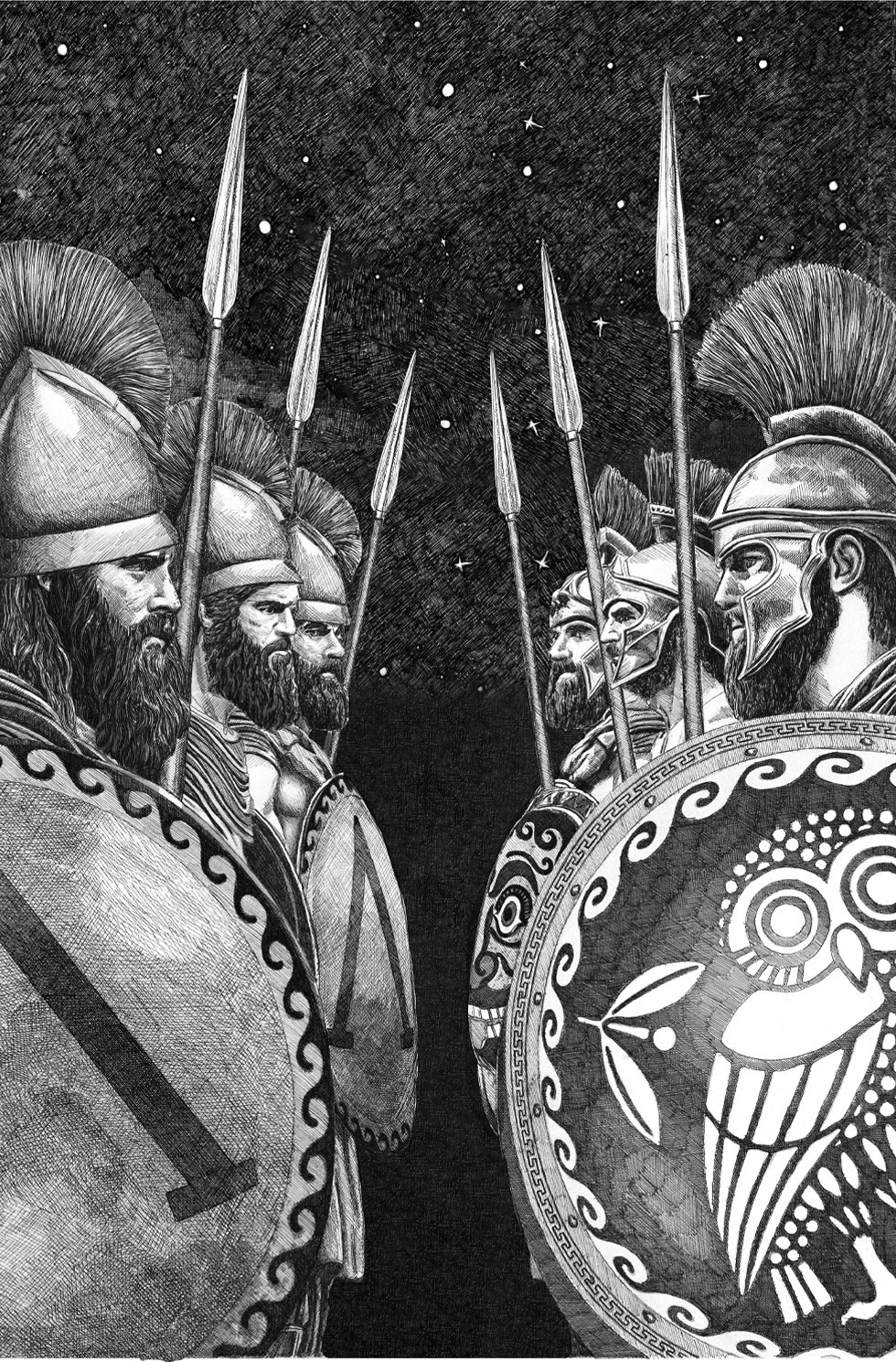
Athenians and Spartans face each other in a tense confrontation, illustrating the rivalry between these two powers. The Athenians wear crested helmets, while the Spartans display more austere helmets and long beards, markers of their identity. The shields reinforce this distinction: Spartan shields bear the inverted “V,” while Athenian shields feature varied motifs. This scene illustrates both the cultural similarities and the subtle differences between the two cities, at the heart of one of the most famous wars of Antiquity.
⸻
Drawing XI — Spartan Hegemony
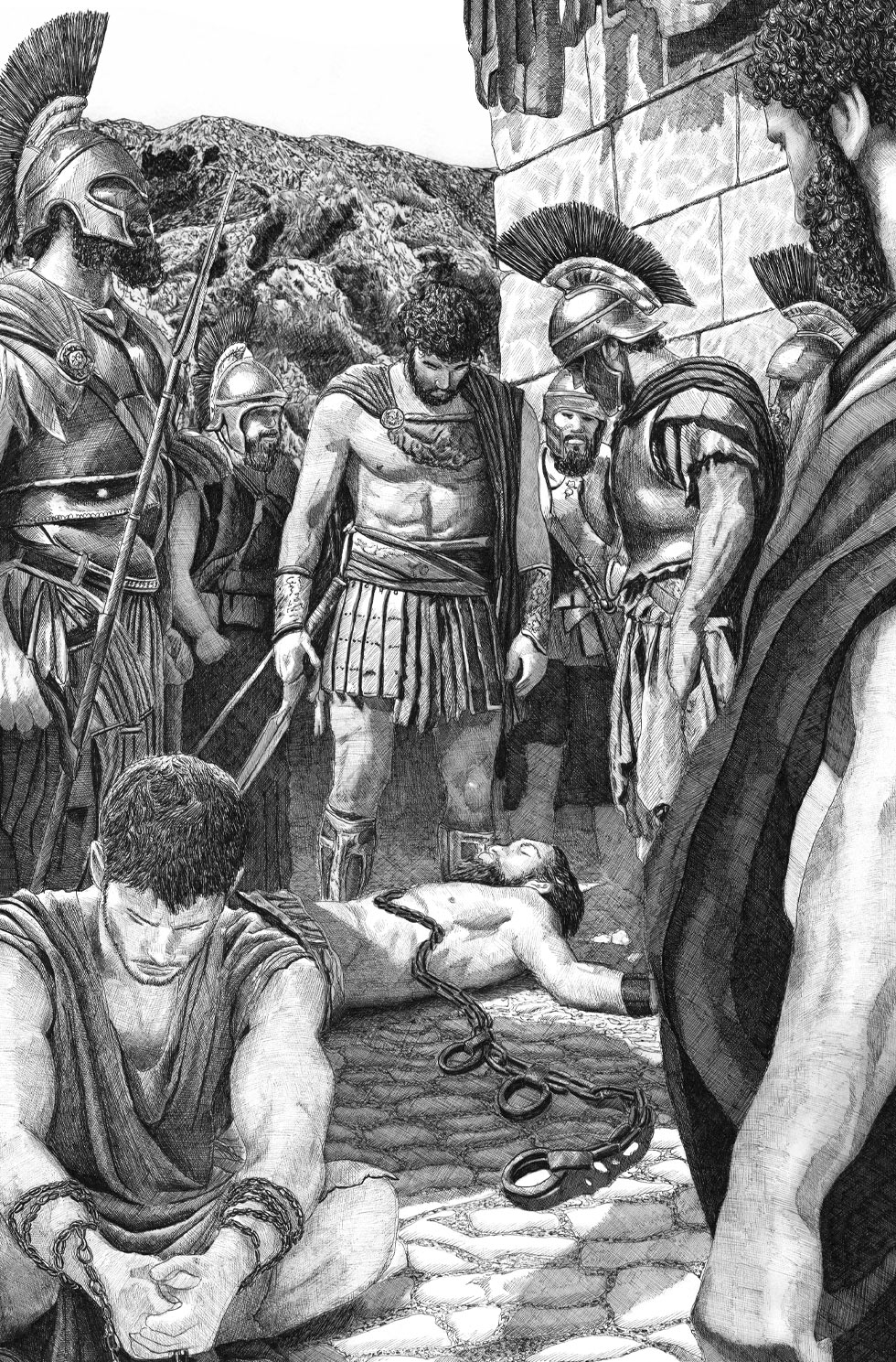
Under the rule of the “Thirty Tyrants,” Athens descends into a period of repression. The scene shows soldiers arresting men, with one prisoner lying on the ground and another crouching and chained, illustrating the inhumanity of this authoritarian regime. This composition highlights one of the darkest periods in Athenian history, marked by tyranny.
⸻
Drawing XII — The Decline
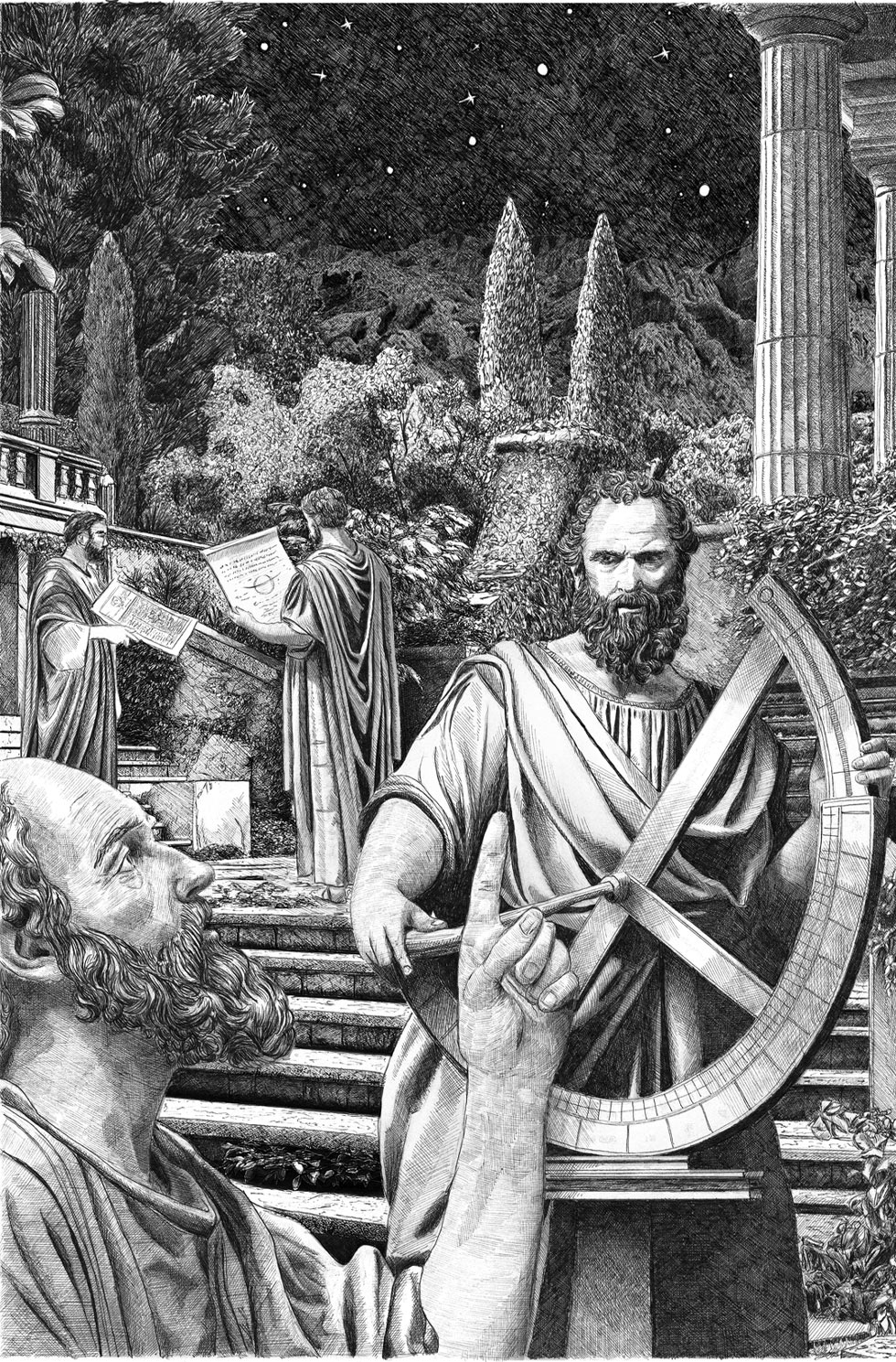
n a peaceful garden, astronomers and mathematicians pursue their research, symbols of a scientific golden age. One astronomer raises his finger toward the sky, while another, on the right, observes a wooden sundial. In the background, Euclid and another mathematician discuss with calculations in hand. Euclid, known for his work on geometry, laid the foundations of modern mathematics with his treatise The Elements. His rigorous, axiomatic method profoundly influenced science and logical thought for centuries.
——————————————
PRESS
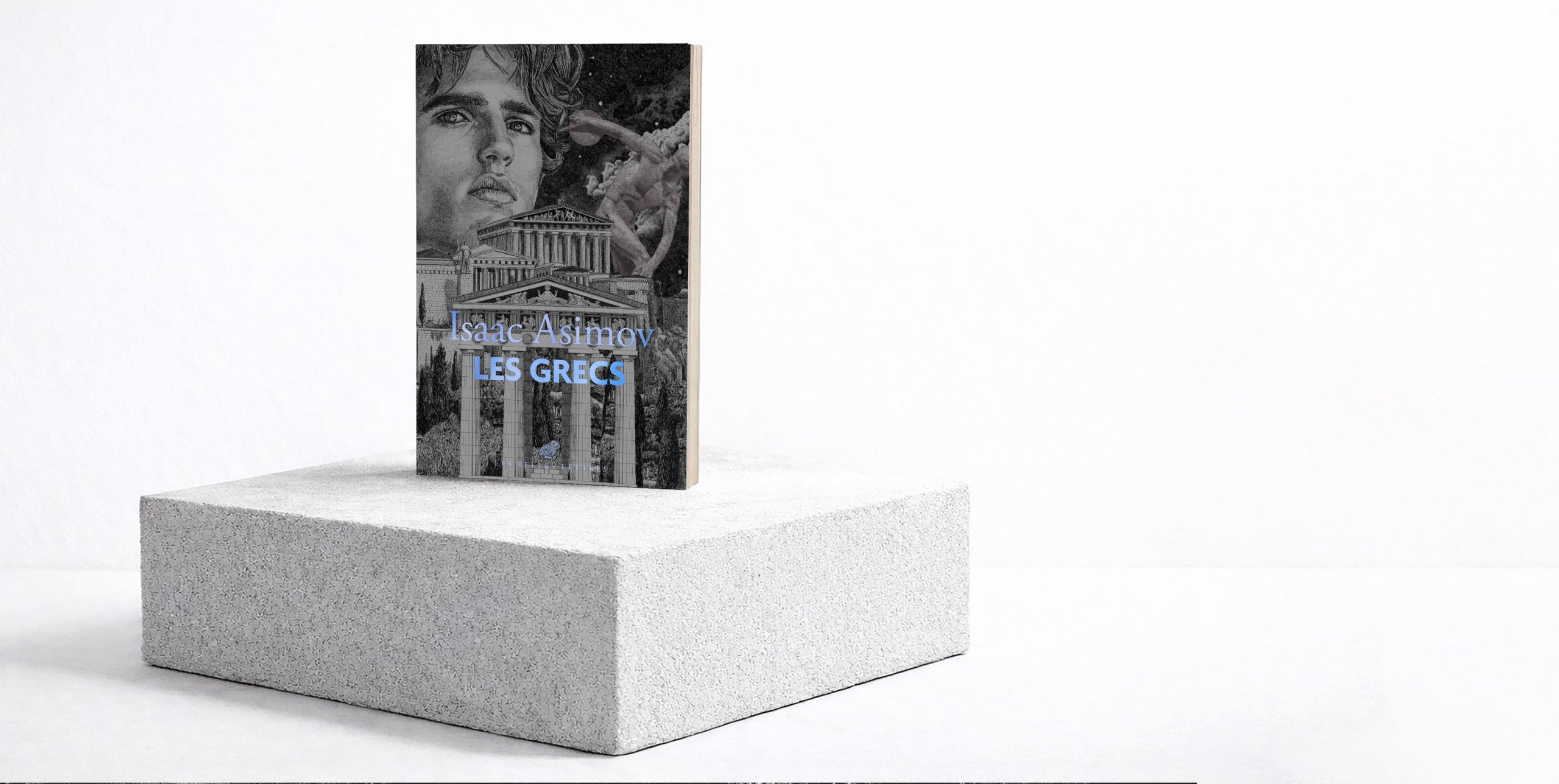
Asimov thus weaves an engaging network of fairly raw information, allowing the reader for enriching back-and-forth reflections. Magnificently illustrated by Benjamin Van Blancke, the book highlights the contribution of this Mediterranean civilization to our own.
A solid introduction to Greek Antiquity and a testimony to the scientific approaches of the 1960s.
Beaux Arts Magazine — 01/07/2025
With remarkable density, Asimov brings the Greek epic back to its essentials. The austere grandeur of Sparta, the political vitality of Athens, and the lightning-fast conquests of Alexander all acquire a rare freshness here, free of unnecessary digressions. Special praise must also be given to the illustrations by Benjamin Van Blancke, which punctuate this compact narrative with an elegant line—evocative without superfluous picturesque detail.
The illustrations by Benjamin Van Blancke are simply magnificent. His precise and poetic line transports us through time, making us feel the warmth of the Greek sun and the coolness of the Aegean Sea. They are a perfect setting for Asimov’s text, a true enchantment for the eyes.
Horizonetinfini on Instagram — 01/07/2025