Publishing
Les Grecs, partie I
Les Belles Lettres
⸻
⸻
⸻
⸻
⸻
⸻
——————————————
PRESSE
Beaux Arts Magazine - 01/07/2025
https://www.lesbelleslettres.com/livre/9782251456959/les-grecs
Production of several illustrations for the magazine L'Hémicycle on the theme of the Palais Bourbon, home of the President of the French National Assembly.
Six first illustrations from the book published by Les Belles Lettres
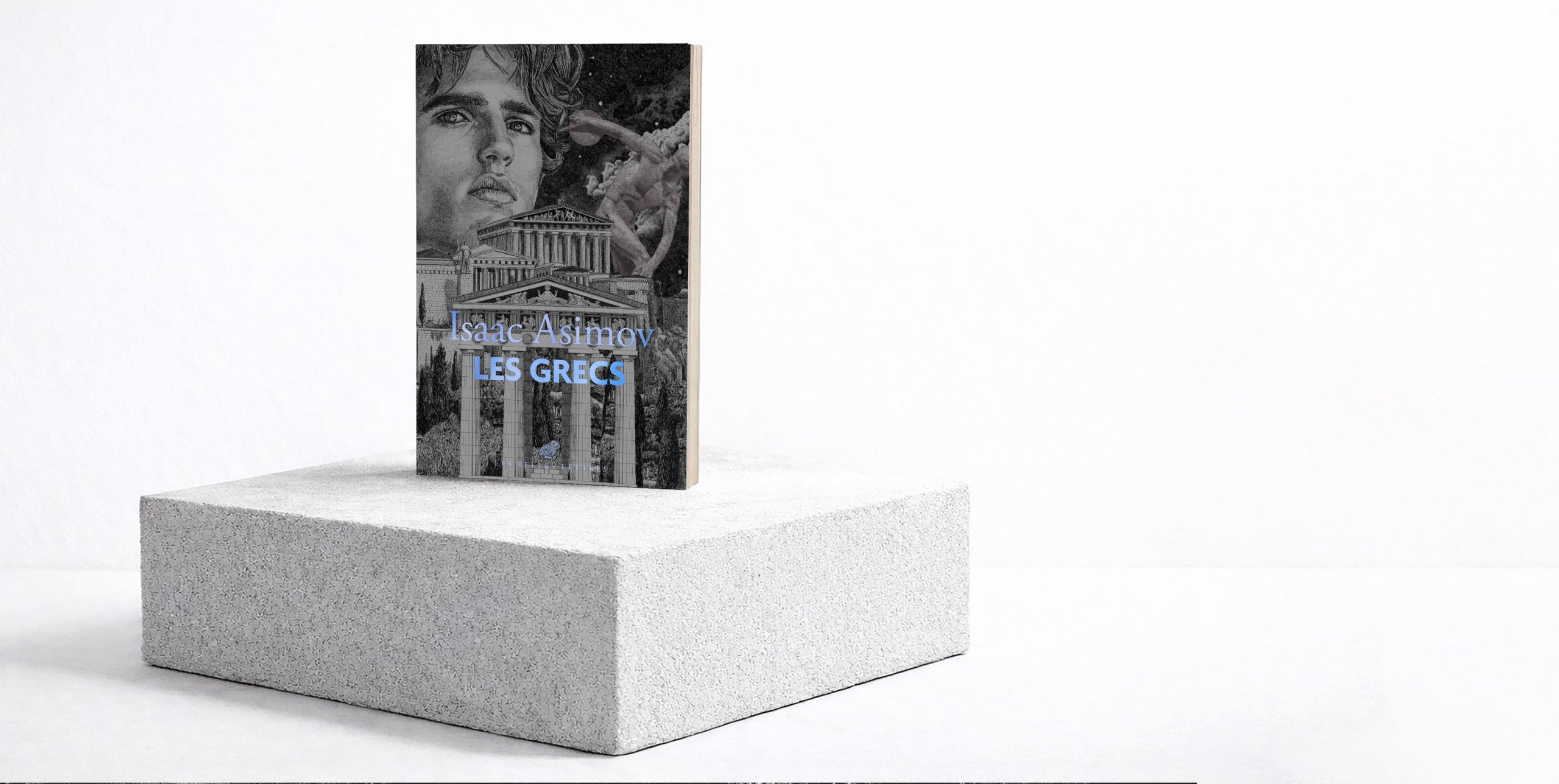
In The Greeks, Isaac Asimov retraces the foundational history of the Greek world by placing it, from the very beginning, within a constant tension between two shores: Europe and Asia.
From the earliest myths to major political upheavals, the Greek epic is shaped through confrontation (Greece and Troy, Greece and Persia, Greece and the Ottoman Empire), a clash of civilizations that extends across the centuries.
The six drawings presented here illustrate the opening chapters of the book. Each one offers a rigorous visual reconstruction, informed by historical and archaeological sources, while allowing room for a sensitive graphic interpretation.
⸻
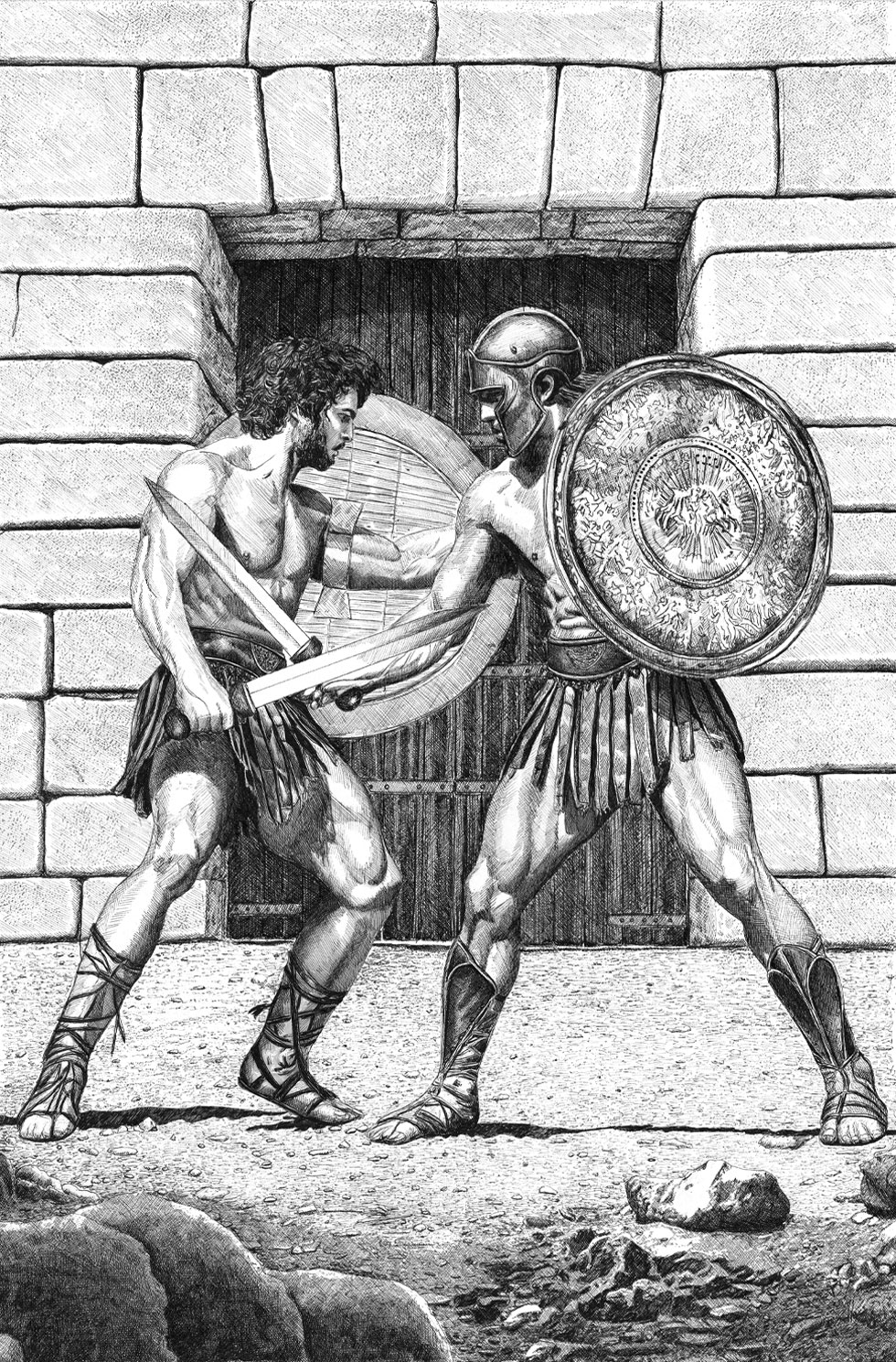
Drawing I — The Mycenaean Era
This illustration depicts an emblematic moment from Homer’s Iliad: the combat between Achilles and Hector before the towering walls of Troy.
Achilles, on the left, is distinguished by his golden helmet, while Hector faces him on the right. Achilles’ shield, richly decorated, is inspired by the famous description in the epic: a work forged by Hephaestus, unfolding the cosmos and the life of humankind. It embodies the splendor and artistic mastery of Mycenaean military art.
⸻
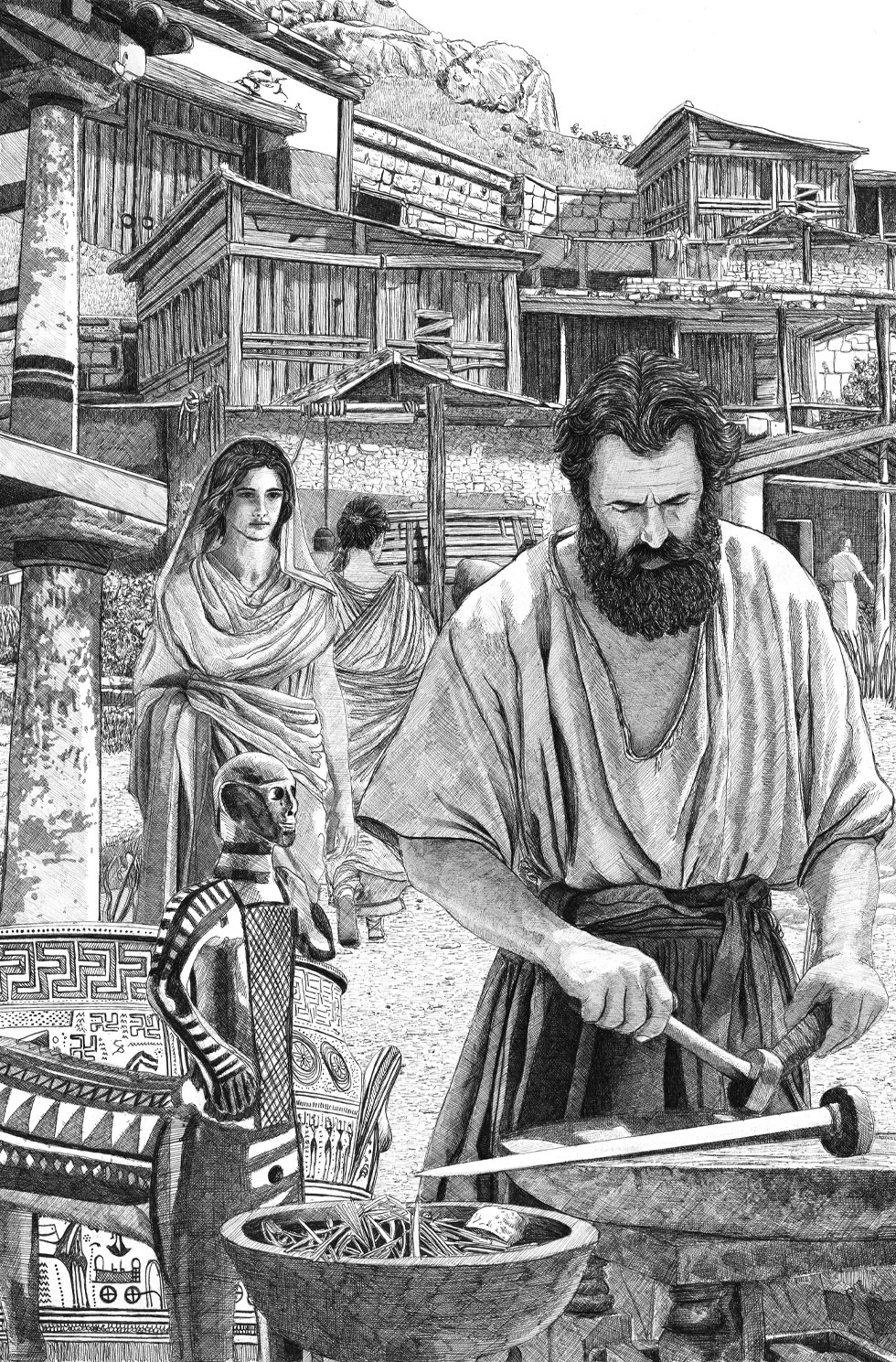
Drawing II — The Iron Age
An archaic Greek city-state unfolds before the viewer. Wooden houses, primitive fortifications, and a lively alleyway form a scene of everyday life.
In the foreground, a blacksmith shapes a weapon, surrounded by fragments of iron, symbolizing newly acquired technical knowledge. Beside him, a vase and a ceramic depicting the centaur Chiron of Lefkandi evoke the emblematic productions of this transitional period.
⸻
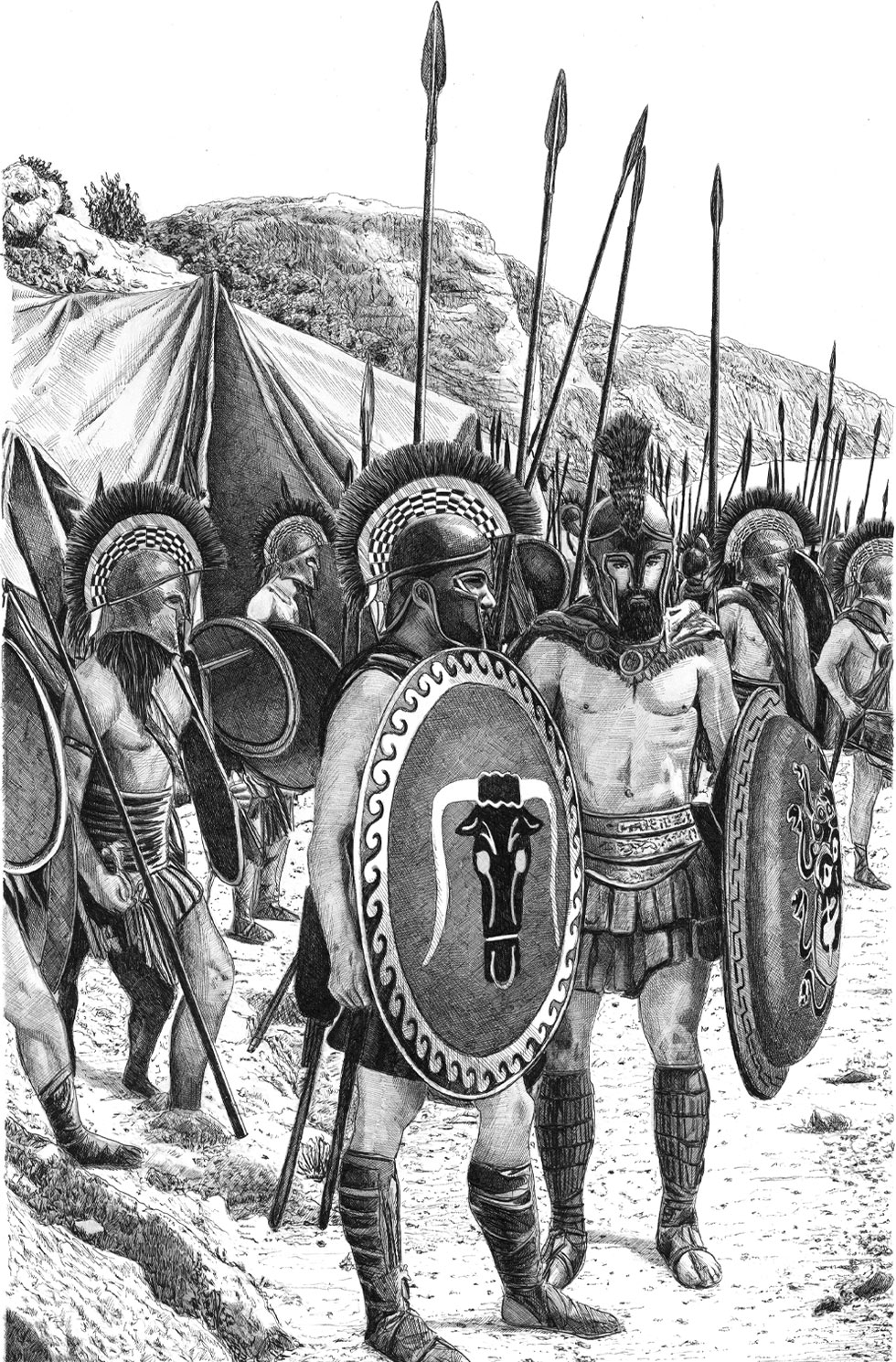
Drawing III — The Age of Colonization
On the shores of the Mediterranean, a camp of Greek mercenaries takes shape. Tents and makeshift shelters testify to the mobility of these warriors.
The hoplites, clad in full armor, wear Corinthian helmets and carry decorated shields and carefully arranged spears. Every detail (from metal gleaming in the sun to the aligned weapons) underscores the discipline and strength of the emerging Greek army.
⸻
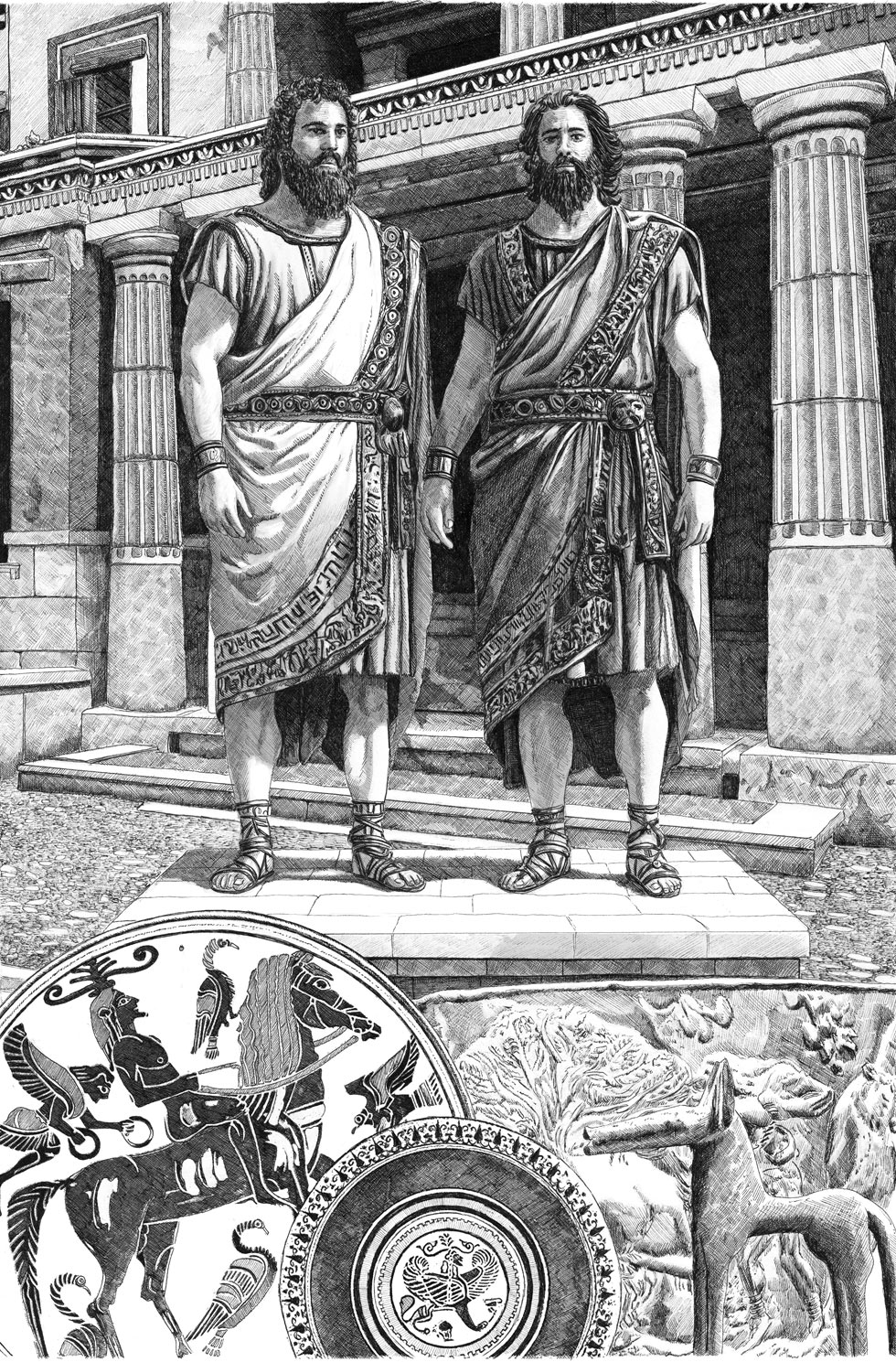
Drawing IV — The Rise of Sparta
The two kings of Sparta, embodying the Spartan dyarchy, stand proudly on a stone platform, representing the royal lineages of the Agiads and the Eurypontids.
Behind them, a deliberately austere palace dominates the scene. Surrounding them, several remarkable Spartan works of art (the gold cup of Vaphio, a bronze horse in the Laconian style, finely crafted tableware) recall a cultural richness often overshadowed by the city’s purely military image.
⸻
Drawing V — The Age of the Tyrants
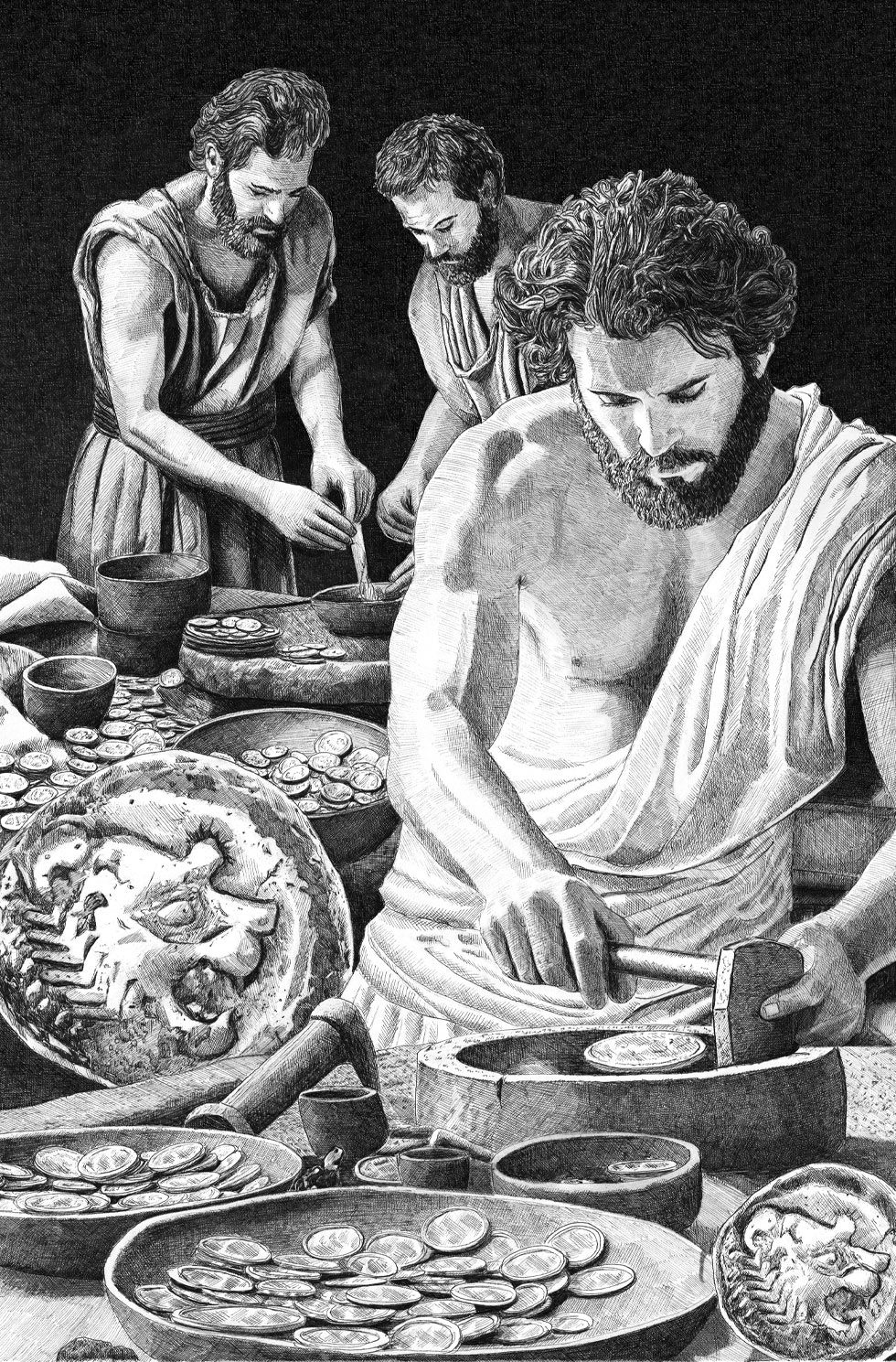
In a modest workshop, craftsmen strike coins. Furnaces, tools, and molds bear witness to the emergence of a new form of power: that of money.
In the foreground, the earliest Lydian coins, adorned with the lion, symbolize the birth of a major political and economic instrument in the history of the Greek world.
⸻
Drawing VI — The Rise of Athens
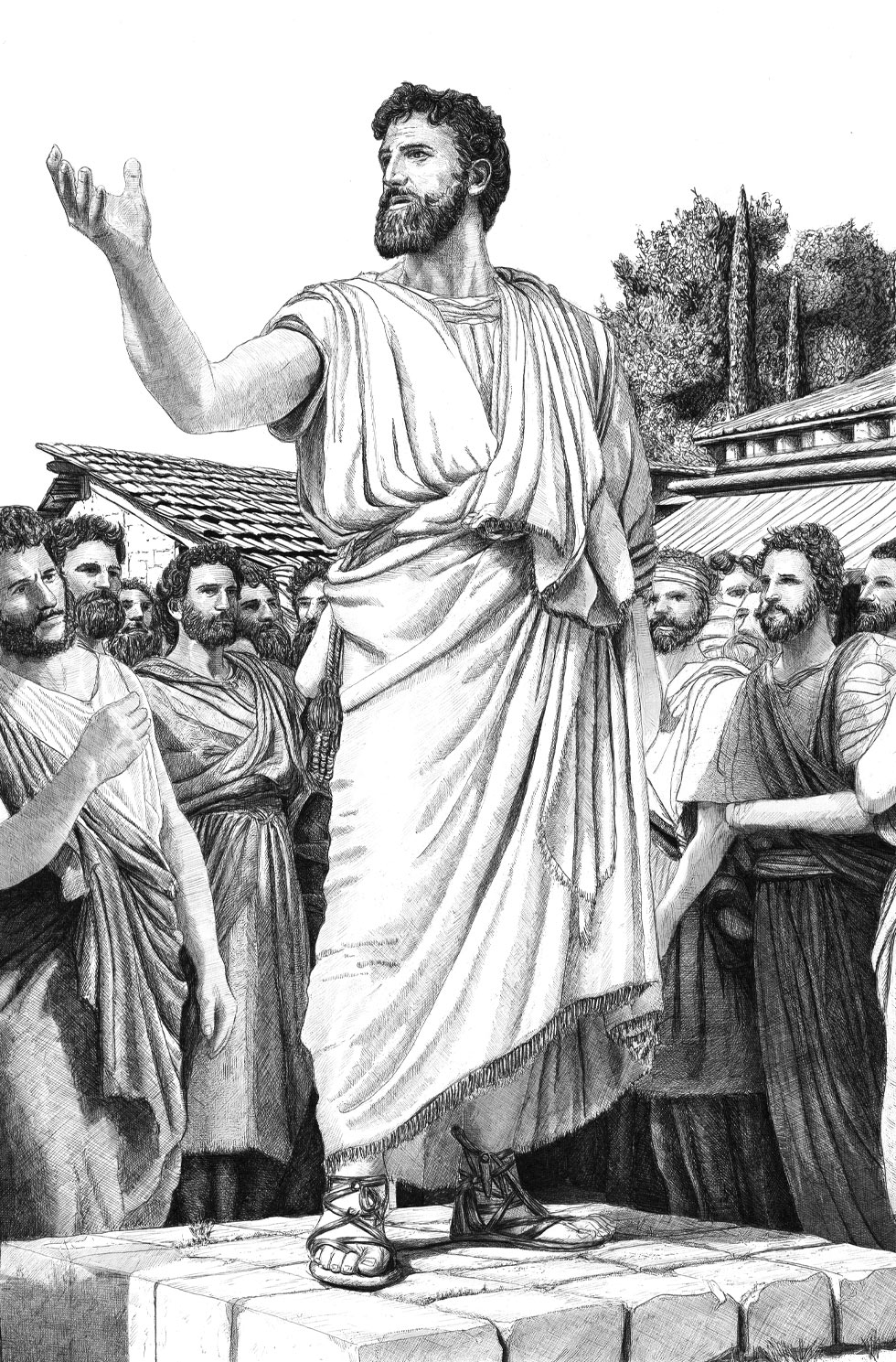
Cleisthenes addresses the Athenian people from a stone platform. Simply dressed, he presents his democratic reforms with eloquence.
Before him, citizens draped in chitons listen attentively. The setting of Athens remains deliberately sparse, without later monuments, in order to faithfully restore the atmosphere of the city at the dawn of democracy.
——————————————
PRESS
Asimov thus weaves an engaging network of fairly raw information, allowing the reader for enriching back-and-forth reflections. Magnificently illustrated by Benjamin Van Blancke, the book highlights the contribution of this Mediterranean civilization to our own.
A solid introduction to Greek Antiquity and a testimony to the scientific approaches of the 1960s.
Beaux Arts Magazine — 01/07/2025
With remarkable density, Asimov brings the Greek epic back to its essentials. The austere grandeur of Sparta, the political vitality of Athens, and the lightning-fast conquests of Alexander all acquire a rare freshness here, free of unnecessary digressions. Special praise must also be given to the illustrations by Benjamin Van Blancke, which punctuate this compact narrative with an elegant line—evocative without superfluous picturesque detail.
The illustrations by Benjamin Van Blancke are simply magnificent. His precise and poetic line transports us through time, making us feel the warmth of the Greek sun and the coolness of the Aegean Sea. They are a perfect setting for Asimov’s text, a true enchantment for the eyes.
Horizonetinfini on Instagram — 01/07/2025